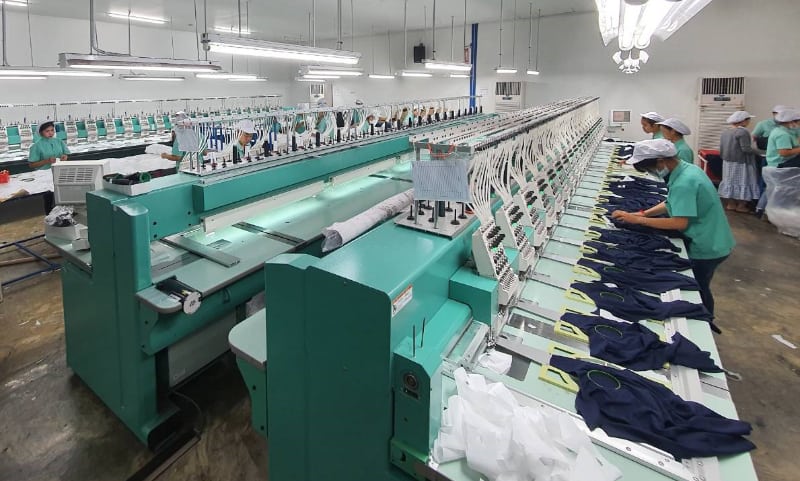
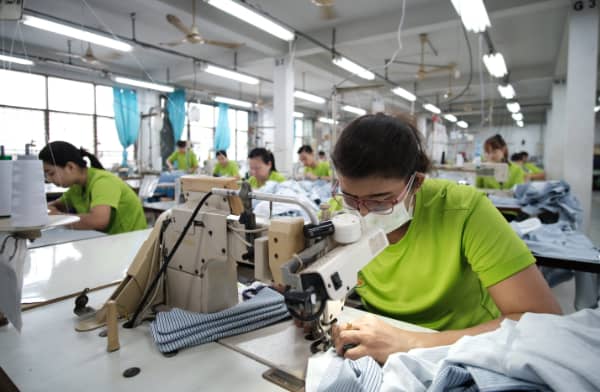
When brands want something new to make their products more exciting they come to Boonchuay Industrial Co., Ltd, where they know they’ll find interesting new developments that they can integrate into their collections.
“We can mix and match various fibers with cotton yarn, and then with our weaving, dyeing and finishing capacity we can create millions of types of products. Each customer can have their own special product with special finishing, and can therefore have unique products that are not going to be found anywhere else in the market,” said Pongpiti Sripolpaew.
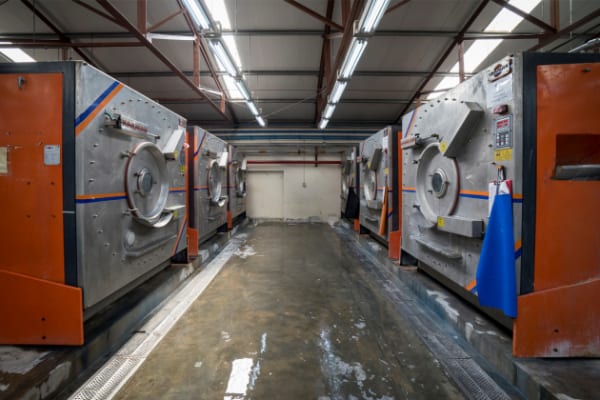
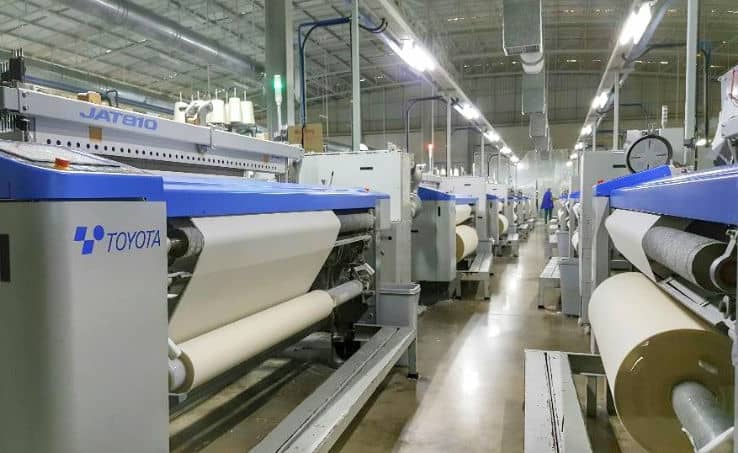
The 60-year old company has made a sizable investment in a wide range of machines that enable them to create more specialized fabrics. In addition, they have added the ability to do digital printing.
“We can mix and match various fibers with cotton yarn, and then with our weaving, dyeing and finishing capacity we can create millions of types of products for our customers.”
– Pongpiti Sripolpaew
“It’s integrated into our culture and values that we always strive to improve on existing products and services. We have ongoing developments so that we can catch the trend of new fibers, new technology, new finishing and new techniques.
“We don’t just wait for customers to tell us what we have to do or where we need to improve. Instead, we proactively look for new suppliers or new technologies and new machines,” he said.
Quality Materials Make Good Products Even Better
While Boonchuay Industrial, which has a capacity of 4 million meters per month, is known for their product innovation, they back those products by using the best raw materials.
“Thailand has positioned itself as a source of high quality reliable garments and textiles. We work very closely with Thai spinners and they mainly use U.S. cotton. I think the big reason behind that is because of the quality and reliability of U.S. cotton.
“The fact that U.S. cotton yarn has no contamination gives us peace of mind that we won’t face problems during our production,” said Mr. Sripolpaew.

Unique Products Backed By a Transparent Supply Chain
Brands are facing the dual challenge of wanting to develop more creative products, but also needing to prove that their supply chains are transparent. To give their customers that assurance Boonchuay Industrial recently joined the U.S. Cotton Trust Protocol® (the Trust Protocol).
“The U.S. Cotton Trust Protocol is an important move for U.S. cotton. We like to have this kind of program, because in the past we always had a dilemma when sourcing cotton, because customers were looking for something that was sustainable and that had certifications. We prefer using U.S. cotton – and now that they are backed by the Trust Protocol program, it’s making the sustainability part of U.S. cotton much more transparent,” said Mr. Sripolpaew.
Building a Brand
The pandemic offered Boonchuay a few hidden opportunities, one of which was to launch their own brand of baby and mother’s products.
“During Covid we started our own brand and built a team for digital marketing and established online sales channels. Then we develop our new products. By selling directly to consumers we get more insights into customer demand and better identify what they are looking for,” he said.
“We see the demand directly from the end customer.”
Going forward, Boonchuay is looking to leverage new technology to gain earlier insights into consumer trends and to grow their brand, as well as continuing to enhance their fabrics.
Email. info@boonchuay.com
Tel. +66 (0) 3431-1369 | https://boonchuay.com/
Certified Sustainable
The Trust Protocol is aligned with existing sustainability programs including the U.N. Sustainable Development Goals. It brings quantifiable and verifiable goals and measurement to sustainable cotton production, and drives continuous improvement in six key sustainability metrics – land use, soil carbon, water management, soil loss, greenhouse gas emissions, and energy efficiency. The Trust Protocol is designed from the ground up to address the unique regulatory and larger farm growing environment in the United States.
How the Trust Protocol Works
The Protocol Consumption Management Solution (PCMS) starts at the gin when the participating producer’s cotton is ginned and each unique Permanent Bale Identification number (PBI) is attached. At this point we know the exact gin weight and can create an exact amount of Protocol Cotton Consumption Units, where one Protocol Cotton Consumption Unit is created for each kilogram of Protocol Verified Cotton. This important step provides absolute authentication of U.S. cotton origin, verifying against the USDA database.
Supply Chain Transparency
The PCMS harnesses blockchain technology through a powerful combination of the Trust Protocol platform and TextileGenesis™ system to deliver full supply chain transparency by recording and verifying the movement of U.S. cotton along the entire supply chain. This creates article-specific transparency for finished products that was not previously accessible to brands and retailers.
Trusted Third Party Certification
The Trust Protocol incorporates a comprehensive program of verification against Trust Protocol benchmarks, in the form of both second-party and independent third-party audits of grower performance through Control Union Certifications—the latter through allocated on-site visits.
Control Union Certifications has certified over 150 industry standards programs worldwide, including working as a key partner in the early development and piloting phases of Impact Claim Verification Protocol.

Learn More https://trustuscotton.org
The COTTON USA Advantage
- Family growers who are committed to working their fields sustainably and leaving them better for future generations.
- A long history of innovative harvesting and ginning technologies resulting in higher-quality cotton.
- One of the highest rates of adoption in the world for Precision Agriculture, which minimizes water and pesticide usage.
- U.S. farmers operate under voluminous, stringent, and enforceable regulations.
- A commitment to transparent partnership that is unmatched anywhere.
- One of the most comprehensive systems for monitoring and measuring all the key metrics involved in sustainability.
U.S. Cotton Facts
- 2/3 of U.S. cotton land uses only rain water
- U.S. cotton water use efficiency has improved by 79% over the past 35 years
- Cotton is carbon footprint neutral, meaning the plants remove more greenhouse gasses than production produces.
Sustainability Goals
The U.S. cotton industry is building upon the strong environmental gains already achieved over the past 35 years. The aim is to help members meet their current needs while making the world a better place for future generations.
Specific goals include:
- Reducing by 13 percent the amount of land needed to produce a pound of cotton fiber
- Reducing soil loss by 50 percent, in balance with new soil formation
- Increasing water use efficiency (more fiber per gallon) by 18 percent
- Reducing greenhouse gas emissions by 39 percent
- Increasing soil carbon in fields by 30 percent
- Reducing energy to produce seed cotton and ginned lint by 15 percent

Learn More www.cotton.org