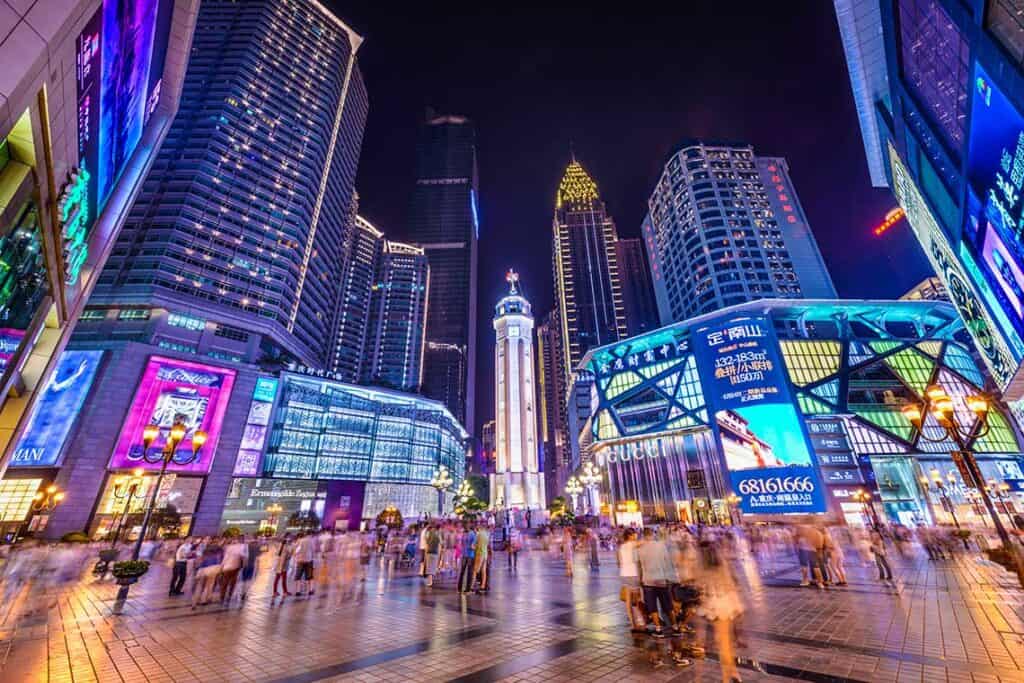
Shopping malls might be struggling to survive in developed markets, however in China they are set to see surging traffic.An urbanization push and a growing middle class that are more likely to spend than save, mean malls - the crown jewel of retail centers - are ripe for investment, according to UBS. The bank said it has challenged “conventional wisdom” that Chinese shopping malls will see little success over the next decade due to lower retail space per capita, underconsumption, and a lack of quality mall operators.China’s malls may have been aided by an unlikely hero: COVID. The pandemic put a ban on global travel forcing Chinese consumers to buy online or in domestic shops - or not buy at all. The government saw an opportunity to give the local retail sector a boost and started allowing its citizens access to duty-free shopping for local travel. The result was massive sales growth in key duty-free outlets. Brands, especially luxury, also realized that they need to remain connected to their biggest customer base and started to refocus efforts on developing retail within China, rather than relying on selling to Chinese tourists. Mall culture could be poised for a huge surge in China. 5 Key Things to Watch Recently, USB made these five predictions for China’s mall over the next five years: More luxury malls are likely to be needed (double 2020's number) A new US$2.8 trillion transit oriented development (TOD) market, which is Environmental, Social and Governance (ESG) positive, is emerging The winner takes all due to the asset-light model The business model is likely to transform from asset manager to investment manager Membership data should further differentiate malls' competitive advantages. Foreign Investors Eye China’s MallsCanada’s Brookfield Asset Management has made China’s biggest retail real estate acquisition since the start of the COVID-19 pandemic by purchasing a set of five mainland malls from joint ventures invested by the Abu Dhabi Investment Authority (ADIA) for $1.4 billion.At the end of May, Brookfield signed sale and purchase agreements for the Mosaic-branded malls in Beijing, Shanghai, Chongqing, Xi’an and Qingdao, according to local media reports. The deal will give Brookfield possession of a portfolio that measures 260,000 square metres (2.8 million square feet) of gross leasable area.A Big Market with Big Growth OpportunitiesThe nation’s growing middle class is becoming a ‘consumption class’ that could start to mimic what we saw in the U.S. during the 80’s to early 2000’s. That’s good news for mall developers.China has stated its intention of becoming a consumer-driven economy rather than its traditional export-driven model. With a population of 1.4 billion, that leaves a lot of opportunities for retailers from mass market to luxury.While many people will argue that Chinese consumers are digital natives and prefer to shop online, many analysts are starting to see things differently.Chinese citizens' buying power has risen faster than the construction of Grade A real estate and infrastructure, leaving brands with only one option - e-commerce. While shopping in brick-and-mortar flagship stores or elegant malls might not be a big deal for consumers in other countries with more developed retail, in China it's a unique and very appealing experience.Malls will not only provide leisure destinations for consumers, they also let brands rise above the noise and chaos of e-commerce platforms.For brands, physical retail will play a more critical role in China, from enabling them to get closer to their customers to serving as delivery hubs and pick up points that support the omni-channel model. Mall Development More new mall space (2.9 sq km) is being built in Chengdu, China than in 89 Western European cities combined. (CBRE) South China Mall (华南), in Dongguan, China, is the world’s largest mall when measured in terms of gross leasable area (almost 660,000 square metres). That’s enough space for 2,350 stores. E-commerce Power Plays See a New Opportunity - OfflineIn 2017 Chinese internet giants Alibaba and Tencent started betting on brick-and-mortar retail with Alibaba taking a 36 percent stake in "hyperstore" (a mix of grocery and department store) company Sun Art Retail Group and Tencent taking a 5 percent stake in Yonghui Superstores.Tencent purchased a stake in commercial property developer Dalian Wanda Commercial Group.A Mall Development Strategy that Focuses on Convenience and LuxuryIn a recent UBS Q-Series report, the bank highlighted malls' polarisation towards dominance (ie, luxury focused), convenience and REIT development. UBS Evidence Lab's data on 1,200-plus malls and 3,400-plus brand stores suggests that more luxury malls are needed in mainland China due to luxury brands' under penetration in tier-2 cities. The key will be locating malls near public transport stations. This is something that’s given Hong Kong malls a big advantage. Easy access plays a key role in driving traffic and in Hong Kong locating malls at MTR interchanges, as well as including malls in mixed use complexes has proven very successful.UBS pointed to China’s new urbanisation policy under 14th Five-Year Plan (FYP) as supportive towards the transit-oriented development model as it preserves land usage and helps drive traffic. They estimate that this could be the next US$2.8 trillion market for developers. On REIT development, while it may not be applicable near term, UBS believes the asset-light model allows mall operators to quickly expand without balance sheet constraints, strengthening their bargaining power and membership-data advantages. Ready for Great RetailAccording to Bain & Co., the U.S. has 3.3 times as much physical shop floor per person as China does. Property brokers estimate that the country’s 330 million people have 30 times as many malls as 1.4 billion China’s do.China not only has fewer retail stores per capita, outside of the tier one and tier two cities, Grade A properties are difficult if not impossible to find. For consumers, physical retail is lacklustre at best. Online, by comparison, is exciting. That could change as more developers invest in building malls and more brands invest in state-of-the-art flagships, similar to what Nike, Apple and others are doing worldwide.CBRE estimates that new shopping mall supply in China's 18 major cities will reach 8 million sq. m. in 2021. With just 10% of new completions due this year situated in prime locations, an undersupply situation is likely to arise in these areas, exacerbated by rising leasing demand.Despite China’s dynamic and innovative e-commerce sector, brick-and-mortar stores nevertheless remain key for both traditional retailers and new market entrants who started out as digital native brands, according to McKinsey & Co. Yixian, the parent company of Perfect Diary Cosmetics, started out online but opened several new physical stores in 2020. Yixian’s stores enable consumers to opt for either express delivery or store pick-up, with fulfillment from offline retail stores having been shortened by one day compared to delivery from logistics facilities. Consumers receive reward points through online shopping or interactive games, which can be exchanged for services in physical stores. This omni-channel approach has helped Yixian see sales rise 73 percent year-on-year in the first three quarters of 2020.