





Over 260,000 short positions were taken out on the S&P 500 futures contract as of Sept 1, according to Commodity Futures Trading Commission data reported by The Wall Street Journal.
LOGISTICS
Excess inventories and weakening consumer demand continues to drive downward momentum in freight rates to both the US and Europe.
Asia – N. Europe rates also fell sharply this week and are now down 25% from May to early August.
The Shanghai Containerised Freight Index (SCFI) spot box freight rate index fell 10% week-on-week but remains more than three times the 2019 average.
The expected demand and Asia to North America volume from shippers to get ahead of Golden Week is in question this year as the Freight All Kinds (FAK) market continues to soften, said Flexport.
Transpacific ocean rates continued their decline this week, with Asia – US West Coast prices decreasing 20% – down 70% from the start of the year, said Freightos.
The port congestion in Europe, particularly Hamburg and Rotterdam, has reached critical levels causing further delays and late return of vessels to Asia, according to Flexport.
Transpacific air cargo rates are decreasing at a time they were already starting to climb last year. At $5.28/kg, last week’s average is also about 50% lower than last year, said Freightos.
Air cargo traffic in July fell by 9.7% year-on-year, the fifth consecutive month of declines, according to IATA.
MATERIALS SOURCING
Automation is Helping This Mill to Offer Greater Flexibility
As a manufacturer “successful digital transformation in order to walk at the same pace with our global brand customers.” said Nutra Uttamapinant at United Textile Mills, a specialist in sustainable cotton knit fabrics.
“We want our factory to be computerized with digital controls. That could come through a series of new machines and lab equipment, more R&D equipment, and other new technology to upgrade our manufacturing facilities,” she said. READ MORE
PODCAST
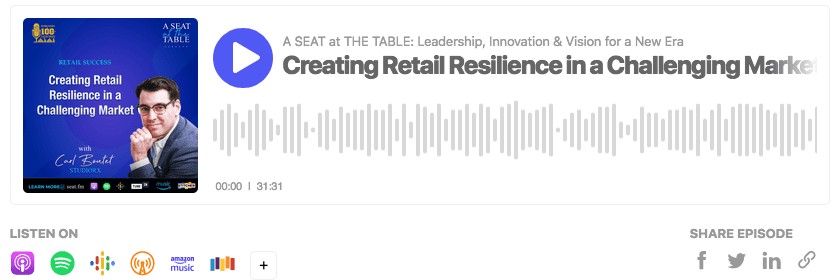
Creating Retail Resilience in a Challenging Market
What can retailers do to get ahead of challenging market conditions – and position themselves to triumph?
In this podcast Carl Boutet, Founder, Chief Strategist & Executive Advisor at Studio Rx discusses what retailers can do to survive – and even thrive – as the market shifts in a new direction.
His master recipe for success = Measure > Analyze > Predict > Prescribe
You’ll Learn:
- Why retailers need to shift their focus from managing cash flows to now putting more emphasis on resource allocation.
- How to leverage the power of physical stores in everything from customer acquisition to community building.
- The value of integrating upstream and downstream data to have better clarity on inventories and better product information to provide to customers.
SUSTAINABILITY
Carriers Could Be the Solution to Cleaner Oceans
New systems on ships are enabling them to clean up ocean water, while delivering cargo. It’s a completely different approach from the previous focus on using greener fuel. And it’s helping to remove some of the pollution from plastics that has escalated from ‘concern’ to ‘crisis’. READ MORE
MATERIALS
The USDA in its latest report cut its global cotton production forecast by 3.1 million bales. However fear of weak demand driven by inflation prompted traders to move cautiously.
Oil futures dropped to an eight-month low around $82 per barrel this week on weakening global demand outlook. Prices have continued to drop since the first week in June.
YOU MIGHT HAVE MISSED THESE ARTICLES
The Value of Defining Your ‘Leadership Brand’
Shifting Priorities Have Companies Taking a New Look at Supply
Retailers Could Face a Chilly 2022 Holiday Season
Are Marketplaces the Next Distribution Channels for Mfgs?
How the Bullwhip Effect Could Cut Inflation & Normalize Supply Chains
