



Nov 1,
Materials prices trend downward; Carriers grapple with falling rates; Central banks pause rate hikes; Yuan and rupee stabilize;

Share This Post

Complexity is impressive. Simplicity is genius.

LOGISTICS

Consumer spending strength is favorably impacting US West Coast container volumes, with increases expected to continue as we approach the end of 2023, according to reports by the Los Angeles/Long Beach port complex. Still, the two ports’ year-to-date volume shows a 20% decline over last year, per UPS.

More and more carriers are reacting to the current market situation, calling rate levels ‘unsustainable;’.  The expectation is for more blank sailings to hit the market in case demand doesn’t pick up soon, per Flexport.

Asia – N. Europe rates increased 8% last week and are just 5% below 2019 levels but remain in loss making territory as carriers continue to struggle with overcapacity on the lane as reflected in reports that carriers will push planned early-month GRIs to later in November, per Freightos.

November GRI was initially announced at $1650-1800 but levels are expected to land closer to $1200. The overall EU trade market remains flat but capacity will be slightly impacted due to the vessel deployment change/suspension in Southeast Asia.  Expect rates to keep dropping, per Flexport.

On Indian Subcontinent to North America routes, rate levels will remain consistent throughout November as demand and capacity begin to balance due to blank sailings

Global air cargo tonnages and rates have stabilized following China’s Golden Week. Despite this, no strong indications of a Q4 peak season are apparent, per Flexport.

Recent increases in e-commerce volumes and significantly fewer passenger flights than in 2019 are likely contributing to rising rates. Asia – N. Europe prices increased 11% last week to $4.30/kg, a 40% increase since early September and their highest level since April, per Freightos.

Presently, worldwide average air cargo rates are -28% from last year, though they’re up +33% from October 2019, sitting at an average of 2.38 US dollars per kilo, per Flexport.

Month-on-Month ocean and air rate changes … new services … seasonal outlookRead More

PODCAST

How to Integrate New Technology without Disrupting Your Organization

Organizations often hurry to introduce new technology, without having explored all the possible impacts it will have on the business – both good and bad.  And without any planning for how to address each potential issue.

In this podcast Pia Wendelbo, founder of Scandinavian Change Agents and former leader of process optimization and organizational change at Finland’s largest bank Nordea, talks about how companies can successfully integrate new technology into their operations.

You’ll Learn:

  • How companies can avoid making key mistakes when digitizing their operations.
  • What organizations can do to help team members embrace change.
  • Why taking a slow approach to digital transformation can lead to faster (and better) results.

🎧  Listen to the podcast

What C-Suite Execs Are Saying

IF Heros Nov 23 Execs

Heading to the end of the year – and with an eye on Q1 2024 – brands and retailers are encouraged by the fact that most major markets have avoided a recession.  However there’s far more caution than in previous years. 

Even luxury is feeling the pinch.  In fact, while luxury has slowed, better brands have an opportunity to shine.   Read more

MATERIALS

Materials prices Nov 2,

BASF (Germany) and Dupont (USA) have lowered guidance citing slowing demand. BASF said it would also cut its five-year investment budget.

Oil prices remained stable – and well below feared ‘$100/bbl’ level, despite the ongoing conflict in the Middle East. 

You can find the current Month-on-Month and Year-on-Year prices here.

CURRENCIES

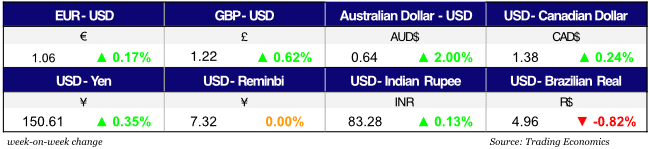
Currencies Nov 2,
  • The dollar strengthened against most major currencies week-on-week.  
  • The Chinese yuan and the Indian rupee have stabilized week-on-week.

MARKETS

  • The Federal Reserve paused further rate increases, but kept open the possibility of additional monetary tightening amid mounting evidence the US economy remains strong. 
  • Weaker Eurozone inflation numbers now have headline inflation running at only 2.9% year-on-year, lower than forecast. 
  • Economic weakness is weighing on inflation in Germany, which fell to 3.8% year-on-year in October from 4.5% in September, per ING Bank.
  • The Bank of England has kept interest rates on hold at 5.25 percent for the second successive meeting, in step with other central banks.
  • The number of US job openings remain elevated, but quit rates and layoffs are back to pre-pandemic levels, per the Labor Department’s JOLTS report.  September job openings remain unchanged from August.
  • The decline in Italian inflation in October was stronger than expected, bringing the headline inflation rate temporarily below the 2% threshold, per ING Bank.
  • China’s composite PMI dropped from 52.0 to only 50.7 – consistent with only very slow overall economic growth. Within this total, the October manufacturing PMI index fell into contraction territory (49.5, down from 50.2), per ING Bank.

Subscribe To Our Newsletter

Get updates and learn from the best

More To Explore

Welcome Back!

Login to your account below

Retrieve your password

Please enter your username or email address to reset your password.

error: Content is protected