

Ikea (Sweden) is making an interesting new investment – in its customers! The retailer announced that it was celebrating its record 2023 growth where sales rose 6.6% to over $6.3 billion.
- The Ikea website now shows “New Lower Price” in red letters above certain products. As well as showing the “previous price” underneath prices for items that are available at lower prices.
- Ikea noted that it was rolling back prices after having raised them due to surging supply chain costs in the past two years.
- Walmart and JCPenney also have announced ‘New Lower Price’ initiatives.
LOGISTICS

Container diversions, as carriers avoid the Red Sea, will take an extra 7-14 days in transit time depending on the lane, and mean a 15-20% increase in costs for carriers, per Freightos.
A coalition of nations, led by the US, is working to create a strengthened naval task force in the Red Sea. The aim is to establish a safe corridor for commercial shipping. As of this week, 121 vessels had rerouted via the Cape of Good Hope, according to Kuehne+Nagel.
On Asia – N. Europe routes, spot rates for the first half of January shot up significantly due to the Red Sea threat. It is anticipated that these spot rate increases will not easily go away even after the Lunar New Year – and a significant peak season surcharge is expected before the Lunar New Year, per Flexport.
All carriers have now introduced a Panama Canal Surcharge to deal with the extra costs caused by the low draft situation, per Flexport.
Surging rates on Asia to N. Europe (+ %) and Asia to Mediterranean (+62%) were likely only achieved on the back of significant blanked sailings by carriers trying to bring high capacity levels, per Freightos.
Rates from Asia to Europe will almost certainly increase due to the higher costs needed to divert ships from the Red Sea. However, excess capacity will help avoid the price spikes seen when the Suez Canal blocked in 2021, per Freightos.
PODCAST

The Critical New Role of Supplier Relationships in Highly Efficient Supply Chains
Supply chain management has become both an art and a science, with executives tasked with building more resiliency, while also increasing flexibility, reducing lead times, and jumping through hoops to comply with increasingly complex regulations.
No wonder most people talk about improving supply chains – but very few actually do. Realistically, it’s difficult enough to simply manage existing systems, without having to try and introduce new ones.
In this podcast Dean Clegg, a supply chain consultant who previously was the Global Sourcing Director at Sainsbury, where he led a complex supply chain through both the pandemic and the transition to Brexit. Prior to that, Dean led the successful integration of Argos stores into Sainsbury’s.
You’ll Learn:
- How to become more efficient and reduce lead times
- Determining the right technology to optimize your supply chain
- The game-changing importance of building seamless supplier relationships.
- Rethinking how we reduce waste to achieve greater sustainability
INSIDE SOURCING
Asia Looks to De Dollarize
A growing number of Asian nations are looking to reduce their dependence on the dollar. China has continued to push trading partners in developing nations to use the renminbi.
Now Malaysia is “actively and aggressively” looking at increasing the use of the ringgit to reduce trade dependency on the US dollar.
Like other nations, Malaysia accepts that most international trade would continue to be done in dollars. However there are growing agreements amongst nations to use local currency for intra-Asia trade. Read more
MATERIALS

Cotton futures traded below 80 cents per pound, down from recent over one-month highs of 82.6 cents per pound, as traders assess updated forecasts for the global demand and supply.
Opec+ now controls barely half of global oil production as the pace of demand slows ‘dramatically’ and US output hits new highs, per The Financial Times.
CURRENCIES
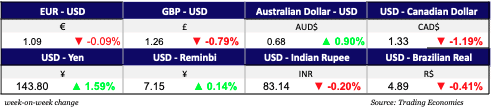
The euro traded below $1.1 as investors expect interest rates in the Eurozone to decrease soon. The pound also fell on speculation that rates would start to fall.
MARKETS
Interest rates will have to stay higher for longer, a senior Bank of England official has warned, dashing expectations of monetary easing next year.
A growing number of investors are expecting the US to make several interest rate cuts in 2024.
The US consumer price index, excluding volatile food and energy prices, increased 0.3% month-on-month in November and 4% from a year ago, per US Labor Dept data.
UK wages have risen at their fastest sustained pace in three decades over the past year, helping to offset the cost-of-living crisis but posing dilemmas for the Bank of England, a new survey suggests, per The Times.
UK inflation slowed more than expected in November to 3.9%, down from 4.6% the previous month, The Financial Times.

YOU MIGHT HAVE MISSED THESE ARTICLES
- Can’t Touch That! Retailers Face Rising Violence
- Mills Pressured to Find New Customers
- SE Asian Markets: Growing Fast, Spending More
- Why Consumers are Giving Canada Goose the Cold Shoulder
- Why Fortune Might Be Favoring Mainstream Brands
- Authentic Denim Becomes an Incubator for Sustainability
- Supermarkets Seize the Fashion Market
- Interfiliere Shanghai: China Re-energizes Intimate Apparel
- Why Mango is Beating Other Fast Fashion Brands
- A New Toolkit for Winning in a Tough Retail Market