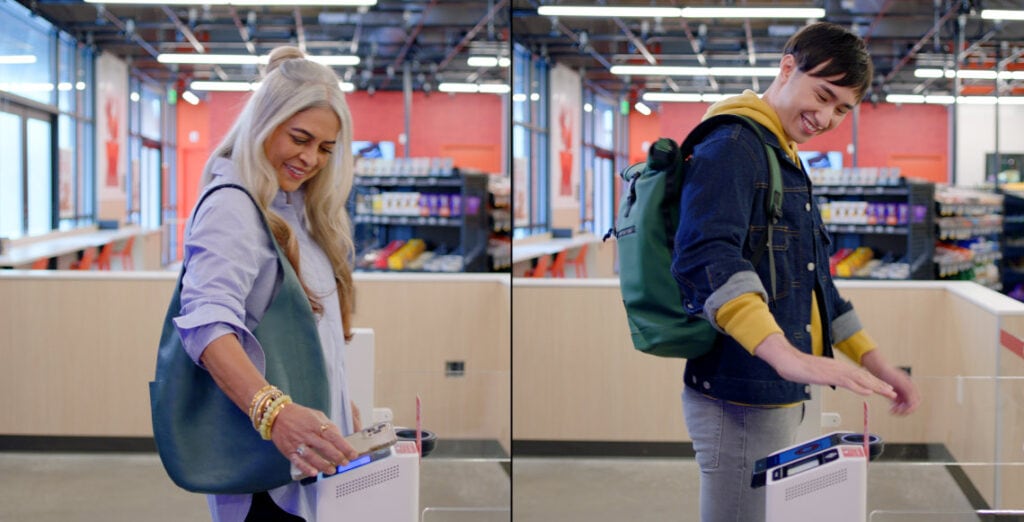
Finding frontline workers has become increasingly difficult and expensive in most developed markets. This is driving retailers to look to technology to help solve this problem.From the rapid growth of self-service cashier stations to more advanced operations, as well as powering warehouses, retail automation is seeing a surge of new innovations from technology companies and new interest from retailers.According to a 2023 Connected Retail Experience Study, retailers are focused on deploying technology to improve operational efficiency.The study conducted by Incisiv in collaboration with Verizon Business, shows that retailers are prioritizing investments in technologies that improve operational efficiency to reduce costs and increase profitability. Retailers anticipate a significant increase in automation and expect up to 70% of routine tasks will be partially or fully automated by 2025. 2023 Connected Retail Experience Study The study also shows that retailers anticipate a significant increase in automation and expect up to 70% of routine tasks will be partially or fully automated by 2025. They expect to leverage the labor and productivity benefits by re-deploying associates to customer-facing high-value tasks (18% of retailers) and support business operations (26% of retailers). Building Efficiency Throughout the Retail EcosystemRetail automation consists of a set of solutions that are primarily designed to automate standard business operations in the retail sector. Various types of retail automation solutions such as POS system, self-checkout system, RFID and barcode scanner, electronic shelf label, autonomous guided vehicle, and others are deployed in retail warehouse and in-store applications. Real-time inventory management has risen to the top of the investment agenda in the face of uncertain supply chain issues that retailers have faced for the last few years. The deployment of artificial intelligence (AI) for improving operations will also increase, with a higher percentage of specialty and department stores adopting it than grocery and general merchandise stores. According to the Incisiv and Verizon Business study:The use of AI to improve operations is projected to increase 9x by 2025.Mobile point of sale (POS) and curbside pickup sensors will significantly increase deployment across all retailers, particularly among specialty and department stores.While the deployment of robotics for associate tasks is still relatively low, it will increase over the next few years, particularly among grocery and general merchandise retailers."Improving operational efficiency is crucial for retailers in today's competitive landscape," said Gaurav Pant, Chief Insights Officer at Incisiv. "Automation is imminent, and retailers must embrace it to streamline processes and reduce costs."Scaling Up and Scaling DownThe increased deployment of new store technologies, adoption of cloud applications, increased customer devices, and increased in-store associate devices will test the store network’s ability to handle additional traffic, particularly when it comes from devices that require low latency and process bandwidth-heavy files.“As the number of mobile and connected devices continues to accelerate in stores, the need for faster speeds, less network downtime and a better ability to manage peak traffic will become more critical,” said Scott Lawrence, Senior Vice President Global Solutions, Verizon Business. “The key is to build a network architecture that will give in-store applications access to the right bandwidth at the right time, and enable them to scale up or down as needed.”