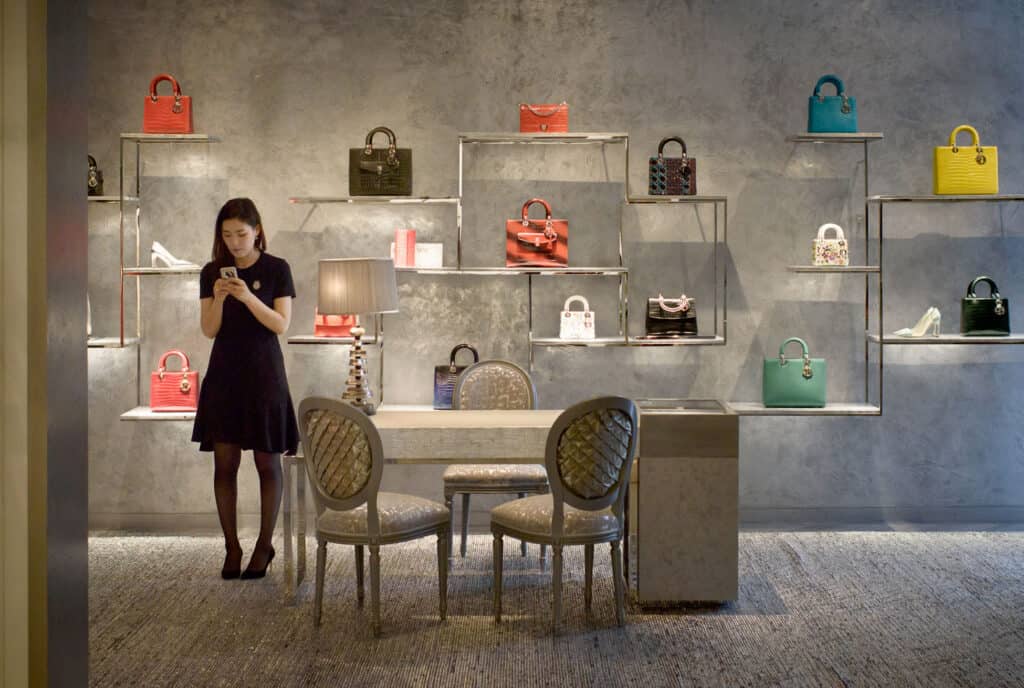
Just as Millennial consumers in Europe and the US are embracing minimalism, their counterparts in Asia are poised to drive luxury goods sales to new heights. However, Asia’s Millennials and Gen Z shoppers however are of a different mindset. Unlike the earlier generation of consumers where luxury purchases were about ‘status for the sake of status’, these young consumers are bring their own values to the table. Beyond brand status, younger luxury consumers want brands that are socially responsible and sustainable. They are also looking for designs that are reflect popular culture rather than legacy styles. Interestingly, Seoul has emerged as the epicenter of Asia’s luxury sector. In March, Chanel launched its exclusive Urban Capsule collection with Pharrell Williams in Seoul. In April, Fendi debuted its street style collection Roma Amor at Seoul’s Lotte Department store. It was the first time the brand launched a new collection in Seoul. These launches not only emphasize how brands are evolving to meet the tastes of younger consumer, but also the growing importance of Seoul as an influencer, not only of trendy K-fashion but also of international designer fashion. <h3><strong>Asian Luxury Market - Bigger Than You Think </strong></h3> While the growth of luxury goods sales, especially in China, is well known, few realize just how dominant the Asian market is becoming. Young Asian consumers account for 35% of consumption. They are expected to account for 45% by 2025, according to a recent report from Bain & Company. By 2035 Gen Z shoppers could make up 40% of luxury buyers. “Gen Z consumers display behaviours that distinguish them from other generations”, said the report. “They see themselves as critical actors of the creativity and conversations with luxury brands; they are returning to products, stores and physical interactions with brands to truly connect and engage emotionally with them”, according to the Bain report. The luxury goods market in South Korea was valued at $12.1 billion last year, up from $9.73 billion in 2014, according to market research company Euromonitor International. It is also the fourth fastest-growing luxury goods market in the world behind India, Malaysia and Indonesia. South Korea's luxury handbag market was valued at $2.7 billion in 2017, making it the world's fourth-largest following the United States, China and Japan. It also outpaced France. "Consumption of luxury goods, most noticeably among the so-called millennial generation, has constantly increased despite a slowdown in the economy," Ha In-hwan, an analyst at Meritz Securities Co., said, adding that international brands are accelerating their push into the country as the market is expected to show continued growth. <h3><strong>Asian Luxury Market in Numbers</strong></h3> • The mainland China market grew 26% during this year to reach $32.3 billion. • Chinese shoppers accounted for 90% of the luxury market’s growth. • Chinese shoppers globally now drive 35% of luxury spending. • Chinese buyers drove luxury sales in Japan, increasing 4% currency-neutral to $26.5 billion while the rest of Asia grew by 6%, reaching $46.6 billion. <strong>70% of Chinese shoppers</strong> bought their luxury goods overseas last year. Brands are now quietly lowering prices in their China stores to encourage consumers to shop at home. • The Middle East saw sales fell 5% to $13.3 billion. • In the Europe sales grew a mere 1% (currency-neutral) to $97.3 billion. • Sales in the Americas were flat at $93.2 billion