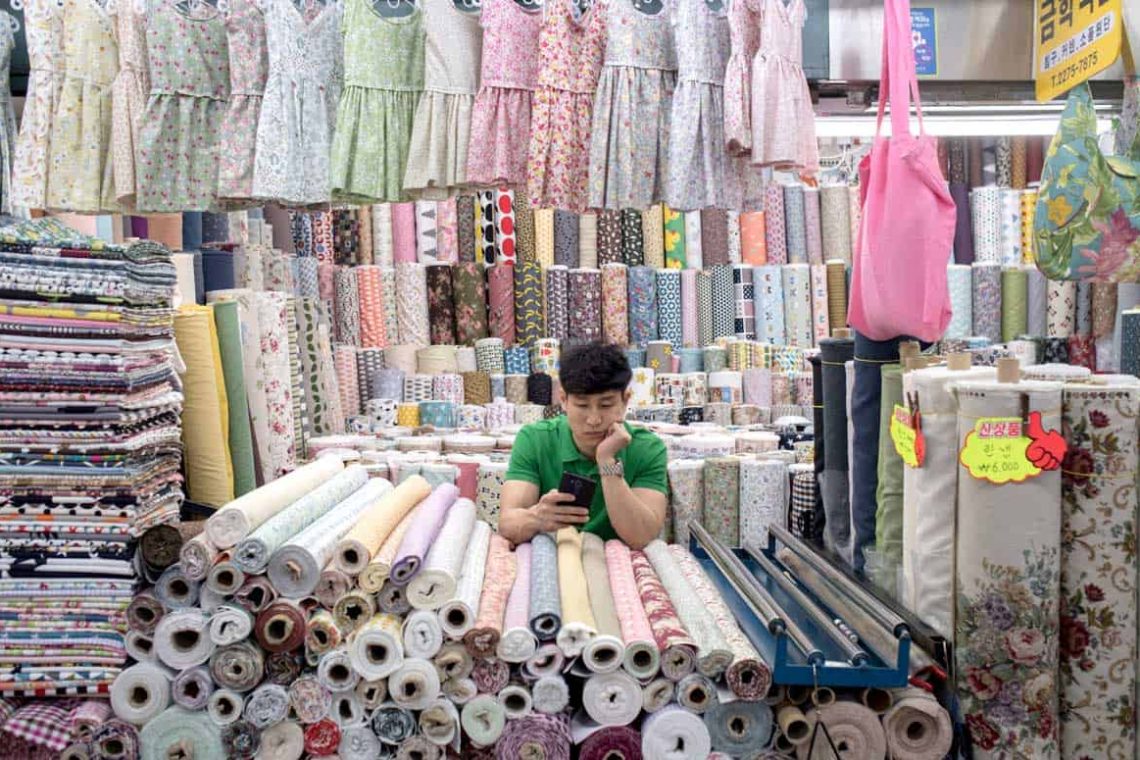
How do you take a massive fabric market, with hundreds of thousands of fabrics in a seemingly limitless variety of styles and colors, and organize it so that buyers can easily search the entire inventory and find what they need? That’s the challenge that SwatchOn faced when the young company decided to find a way to turn the massive amount of fabric swatches at Seoul’s famous Dongdaemun market into an export business. The motivation for the company was to contribute to making the fashion industry more sustainable. “We recognize that it is time to drive change, and that it may be challenging to motivate people and industries to move toward sustainability. We believe that taking part in this movement ourselves and doing what we can do to nurture a culture can be an engine for sustainable change,” the company said in a statement. “Our mission is to revitalize the Korean local fabric market Dongdaemun, which consists of over 3,000 small fabric suppliers,” said the company. In the 1970s Korea was one of the leading exporters of textiles, but it has since been overshadowed by China’s powerful textile industry, which now supplies most of the region’s fabric needs. “Our Korean fabric suppliers have been working in the fabric market for over 30 years with excellent techniques to produce high quality fabrics. However, they do not have the appropriate resources and manpower to diversify sales channels, especially in regards to exporting products overseas. Our main mission is to support them and help them prosper,” said SwatchOn. <h3>Turning Trash to Treasure</h3> Korea’s Dongdaemun market consists of local Korean suppliers selling stock products. Unsold fabrics tend to end up as trash since the many small vendors who comprise the market have no outlet for selling or repurposing this leftover stock. SwatchOn was founded with the mission to minimize environmental wastes by expanding the local market to a global market. “It is no news that unsold clothing inventory is a huge waste and that it harms both the economy and environment. There is a great concern about the environmental impact of producing too many goods and then destroying them. This is the main reason why SwatchOn makes sure that we carry products that can be sold with no minimum order quantity,” according to SwatchOn <h3>Serving Small Orders</h3> “We are all about exposing stocked fabrics online and making it accessible all around the world, so that they can be sold even in small quantities to designers who need them. We believe that helping fashion designers to purchase fabric with no minimums will eventually contribute to producing less unsold clothing as well as unsold fabric. Even though we are selling stocked fabrics, designers do not have to worry about products getting out of stock and not being able to re-order, since we will always find replacements as we have access to more than 2000 suppliers,” said the company. SwatchOn continues to make progress towards carrying fabric products from sustainably managed sources. The company does not work with suppliers that produce leather/fur and carries leather/fur alternatives only. <h3>Tackling Transparency</h3> SwatchOn is doing its best to improve transparency of our fabric supply chain and working hard to provide as much relevant information to all its trading partners. “The main challenge is to convince our suppliers to be equipped with relevant documents on their production process, and be completely transparent,” said the company. Since SwatchOn has more than 100,000 listed products from 2,000 suppliers, it will take time to convince their suppliers, collect all the relevant information, check its accuracy and upload online. This is one of their key challenges, and is a major area that needs improvement. “Our ultimate mission is to bring positive changes to the Korean fabric market, especially towards sustainability. We believe that even small changes matter, and will work hard so that every aspect of our business can have an element of sustainability,” according to a company statement.