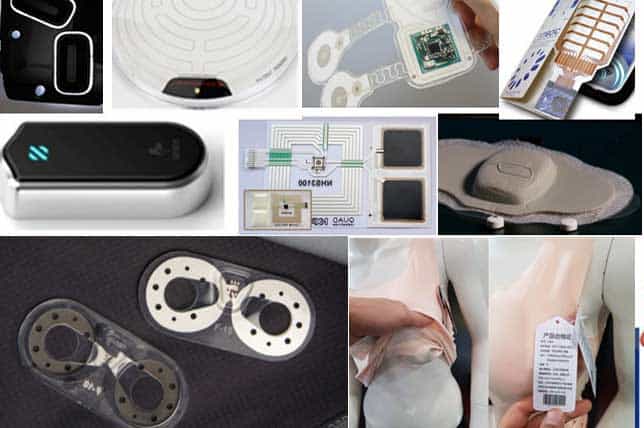
New developments by IDTechReseach (USA) is pioneering In-Mold electronics, flexible hybrid electronics, e-textiles, and skin patches. <h3><strong>Flexible Hybrid Electronics (FHE)</strong></h3> This emerging technology frontier allows printed electronics to be combined with, or hybridized with, rigid ICs and electronics, thus marrying the best of both world A limiting factor, thus far, for printed electronics has been that many components, such as logic and memory, are either non-existing and don't come close to matching the cost and performance of non-printed technologies. FHE is of course not straightforward to implement. Thinned ICs are being developed to enable flexibility. Novel attachment techniques, such as low-T solder or photonic sintering, are being developed to enable the transition from the expensive PI to the low-cost and low-temperature PET. At the first instance, digital printing is likely to be employed, cutting turnaround times, allowing customization, and producing limited units. In the longer run, high-throughput roll-to-roll techniques will be required. This will require innovation on rapid pick-and-place on a roll able to handle thin ICs. This is a major innovation opportunity. In the long term, this technology will enable flexible, complex, and relatively large circuits to be rapidly produced. Imagine the multi-billion-unit RFID business but imagine more complex and larger area circuit lines as well as larger and more powerful ICs. This is the long-term transition. Conductive inks will play a central role here. Rapid sinter/cure technologies will be needed to enable high-throughput production. Low-cost is also essential. To address this, new copper formulations are being offered that seek to overcome the cost/performance trade-offs and to enable simple and rapid sintering. Narrow linewidth and high-throughput printing will also be needed to support complex ICs with many closely spaced I/O pins. This will be an increasingly important area. At first, the industry will be led by many well-funded research centres. However, the transition to commercial production will soon take place in earnest. <h3><strong>In-Mold Electronics</strong></h3> In-Mold Electronics is projected to exceed $1Bn by 2029 at the product level across automotive, consumer goods, wearables, and home appliance applications. The progress will start with smaller and simpler devices launching in areas where reliability and product lifetime requirements are more relaxed. It will then transition into more challenging markets. In other words, this time around, the industry will probably learn to walk before it runs. IDTechEx expects the automotive market to adopt IME products starting from the 2022-2023 period. IME is no longer a young field. The first products were launched more than five years ago. Conductive ink innovations have played a key role in enabling this method. Today, many inks are available. Suppliers are seeking to bridge the conductivity gap with standard conductive inks, to improve reliability individually and as part of a stack, and to extend the limits of stretchability. The innovations are mainly on the formulation step and the powder requirements are rather relaxed. The product development works have been undergoing as such the early pioneers are well placed to reap the rewards when the first generation of products launches. Once the requirements become more standard more suppliers can enter the business.