

AI isn’t a feature. Instead, it unlocks features.
“The most interesting applications of AI are those that see it as a substrate for building features, rather than as a standalone feature,” said Ben McRedmond, Co-founder and CPO at Equals
LOGISTICS

There are reports of inventory shortages for some European importers as shipments are delayed or taking longer to arrive, per Freightos.
Demand for rail has surged on the China-Europe network. Compared with this time last year, some rail operators are reporting as much as a 68% increase in rail requests along with a 43% increase in bookings, per J M Rodgers Co, a freight broker.
There are still reports of tight space and equipment at Asian export hubs, congestion remains minimal, however there are signs space and equipment availability may already be improving, per Freightos.
Carrier steps to adjust and accommodate the new longer routes should improve reliability in the coming weeks. And with pre-LNY urgency likely a significant contributor to rate increases in January, freight rates may be reaching their ceiling, per Freightos.
Shippers are moving cargo to air to avoid disruptions in the Red Sea. Air cargo volumes spiked 62% on the Vietnam-Europe route, a 16% year-over-year increase, per J M Rodgers.
The Baltic Air Freight Index reported a 6.4% rise in rates, with larger jumps seen in some outbound Asian markets. Global air cargo rates have increased for the first time in nearly two months ahead of Lunar New Year and on increased demand as shippers shift to air to avoid inventory short falls, per UPS.
Inside Fashion reduces everything down to only what's essential
INSIDE SOURCING
The conflict in the Red Sea has been the most recent challenge for the apparel supply chain. However, analysts say that the disruption is far less than when the Ever Given blocked the Suez Canal in 2021.
“Businesses look to be in far better shape to weather any potential supply disruption today without having to resort to immediately lifting prices,” said Wells Fargo
- While some shippers will see higher costs, a better balance between inventory and customer demand means most retailers won’t need to raise prices, per Wells Fargo.
- After facing the pandemic and the Suez Canal blockage, shippers are more prepared for issues facing the supply chain, per Drewery.
PODCAST

Why More Int’l Companies are Partnering with Malaysia
A growing number of companies are looking for new supply chain opportunities.
In some cases, they are looking for new capabilities. Others are targeting risk reduction. And of course, there’s the ongoing demand for better prices.
That’s continued to put Southeast Asia in the spotlight.
In this podcast Yazrin Syakhairi Mahlan, Consulate General of Malaysia in Hong Kong, talks about some of the unique opportunities and new developments from Malaysian companies.
You’ll Learn:
- Malaysia’s unique role in the regional and global supply chain.
- Key opportunities for international businesses to collaborate with Malaysian companies.
- How Malaysia is positioning itself for the future.
MATERIALS

Cotton prices hovered around a 3-month high on expectations of strong demand.
Saudi Arabia has ordered oil giant Aramco to cap its oil production at 12 million barrels per day. Previously, Aramco planned to boost production to 13 million barrels per day.
MARKETS
The US Federal Reserve held interest rates at a 23-year high this week, but gave little indication of when it would begin cutting borrowing costs this year.
The Eurozone managed to just avoid a technical recession in 4Q23, but at 0.0% growth in 4Q23, per ING Bank.
France’s inflation came in at 3.1% in January 2024, compared with 3.7% in December, according to INSEE. The slowdown in price growth was sharper than expected.
The German economy shrank by 0.3% in the final quarter of 2023, following six months of flat output, per the Federal Statistical Office. ING Bank said that the nation’s economy was in a “shallow recession”.
China’s January PMI edged up to 49.2%, from 49% in December. New export orders rebounded from the low of 45.8 to 47.2, per CEIC data.
Australia’s inflation fell to 3.4% in December, from 4.3% in November, per the Reserve Bank of Australia (RBA).
CURRENCIES
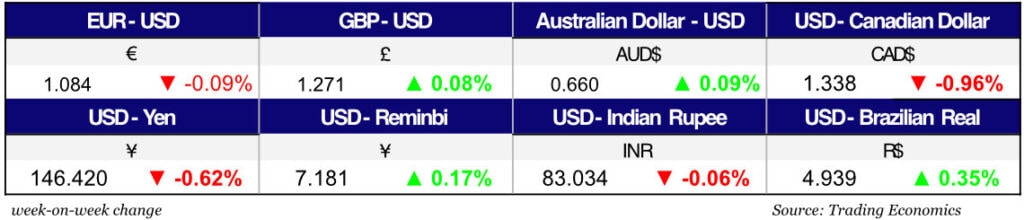
The euro remained under pressure at the end of January, hovering around $1.08, its weakest level since December 12th, as investors digested inflation and GDP data from Europe’s largest economies.
The offshore yuan was subdued around 7.19 per dollar as investors reacted to an official report that showed that factory activity contracted for the fourth straight month in January, in line with expectations, amid soft domestic and external demand conditions.

YOU MIGHT HAVE MISSED THESE ARTICLES
- Volumes Remain a Challenge, Even As Markets Stabilize
- Why Primark Keeps Beating the Market
- How Five Below Keeps Consumers Coming Back
- Overlooked Opportunities in Pakistan
- Can’t Touch That! Retailers Face Rising Violence
- Mills Pressured to Find New Customers
- SE Asian Markets: Growing Fast, Spending More
- Why Consumers are Giving Canada Goose the Cold Shoulder
- Why Fortune Might Be Favoring Mainstream Brands
- Authentic Denim Becomes an Incubator for Sustainability
- Supermarkets Seize the Fashion Market