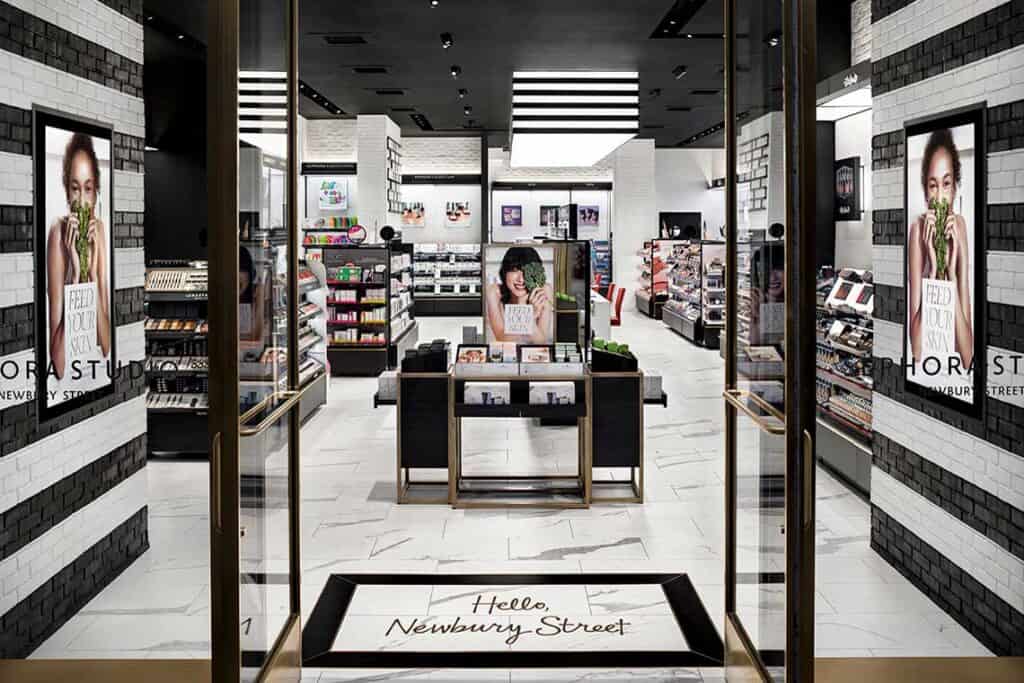
After years of a ‘bigger is better’ mindset, suddenly retailers around the world are seeing smaller stores - even micro stores - as the retail format of choice. The pandemic forced retailers to rethink their strategies. One thing that came under the microscope was retail channels with physical retail having to defend itself in the face of the soaring sales that e-commerce was racking up. While many retailers have erred by overlooking the importance of developing an e-commerce channel, even more made the grievous error of opening flagships where much smaller stores would have been just as effective - and much more profitable. One of the key learnings from 2020 is that for anyone other than the well-established e-commerce giants, physical retail is a key profit driver, plus you can more easily gather ‘soft data’ about your customers, you can more effectively create a personal connection with customers and you can capitalize on impulse purchases. Thus, brands have started to reimagine retail in more strategic locations with better edited assortments that are aligned with consumer demand in each market. The flexibility of smaller stores makes this more achievable. <h3><b>8 Opportunities for Smaller Retail Stores</b></h3> <ol> <li aria-level="1">Stores are now doubling as fulfillment centers</li> <li aria-level="1">More targeted merchandise assortments</li> <li aria-level="1">Greater personal service</li> <li aria-level="1">Convenient shopping </li> <li aria-level="1">Establish a presence in new markets</li> <li aria-level="1">Aligning retail space with the volume retail sales</li> <li aria-level="1">Build a sense of community</li> <li aria-level="1">Flexibility - that all-important ability to stay one jump ahead of the market</li> </ol> <h3><b>Reaching New Markets</b></h3> Smaller stores can enable big retailers to divide and conquer. By having several smaller stores rather than one large flagship, they can spread out into new locations. Ikea, typically a mega format with suburban stores, has introduced smaller stores designed for malls and urban retail locations. Uniqlo, typically a high street and mall retailer, is now opening roadside stand alone stores in more rural or smaller suburban locations so that they can serve customers who want the convenience of shopping nearer to home. The ‘local’ and ‘nearer to home’ consumer mindset is key. While luxury goods might be able to overlook this and focus their retail efforts on major cities, mainstream and mass market brands need to consider these untouch locations as attractive new opportunities. The days when stores were simply a place to acquire goods have long passed. If consumers want an impersonal experience, they can simply shop online. However, most want more personalized service and physical stores have an opportunity to capitalize on this, and at the same time gain a better understanding of what the consumer wants. <h3><b>Making Multi-channel More Profitable</b></h3> E-commerce is driving sales but retailers are finding that profits are not growing as quickly. In some cases, they are not growing at all. From delivery costs to merchandise returns, e-commerce is not the free ride that many thought it was. A growing number of retailers are realizing that they can repurpose physical stores so that they serve double-duty as stores and as fulfillment centers. Managing decentralized inventory could be tricky, but the savings on last mile delivery and merchandise returns could justify the move. <h3><b>Collaborating to Drive Traffic</b></h3> Traffic is essential to growing sales and brands are thinking out of the box in order to find cost-efficient ways to get more people in the door. A proven strategy is the shop-in-shop format. By taking small space within a bigger store a brand can capitalize on an already existing stream of customers. At the same time, it is bringing newness plus its own customer base to the larger store. It’s a win for everyone. John Lewis Partnership (UK) is the latest of the big retailers to adopt this strategy. The iconic UK department store is planning to overhaul its presence on the high street by opening hundreds of mini-stores in Waitrose supermarkets. In the UK, Habitat was a leader in the strategic use of small format stores when in 2017 it started putting mini Habitat store-in-store within Sainsbury supermarkets. The company said that it helped establish Habitat’s brand awareness with Sainsbury’s customers, as well as helping to build online shopper confidence. Sephora recently signed a deal with Kohl’s to open shops within Kohl’s. <h3><b>A Hybrid Niche Strategy</b></h3> A key advantage of smaller retailers is that by focusing on one market segment they can become the go-to place. When bigger retailers scale down, they are forced to tailor their merchandise to a more precisely defined customer profile. Last year Bloomingdale’s (USA) announced that it planned to introduce a smaller, highly edited and service-driven format and was looking at stand alone, non-mall locations. Target (USA) is a traditional big box retailer that has invested in small-format stores to address the need for a different target customer, such as college students or those living in urban cities. Nike Rise stores is another example. Nike is using this concept to create localized stores that tap into the culture of different cities and communities within its global footprint. The stores work as part of the Nike eco system that includes its dynamic flagship stores in major international cities. A pioneer of this concept was Sephora (France), which in 2017 rolled out its Sephora Studio format, a scaled down version of its large stores equipped with digital technology to enhance the customer experience. “In today’s retail environment where very little is constant and clients’ expectations are ever-evolving, there is no better way to create meaningful connections with clients than through personalized experiences and a customized approach to beauty,” the company explained, noting that Sephora Studio was launched to build this close connection with the customer. <h3><b>Not For Everyone</b></h3> The shift to small stores is not for everyone. An earlier mover in the small format movement, Walmart ended up closing its unsuccessful Walmart Express stores in 2016. Aside from low prices, consumers like Walmart’s massive selection. Somehow a mini Walmart failed to resonate with its core customer base. For apparel brands, that’s not an issue. Small formats have less floor space and require less inventory and fewer staff. Looking ahead, we expect to see more retailers changing direction from an emphasis on flagships to a roll out of small format stores.