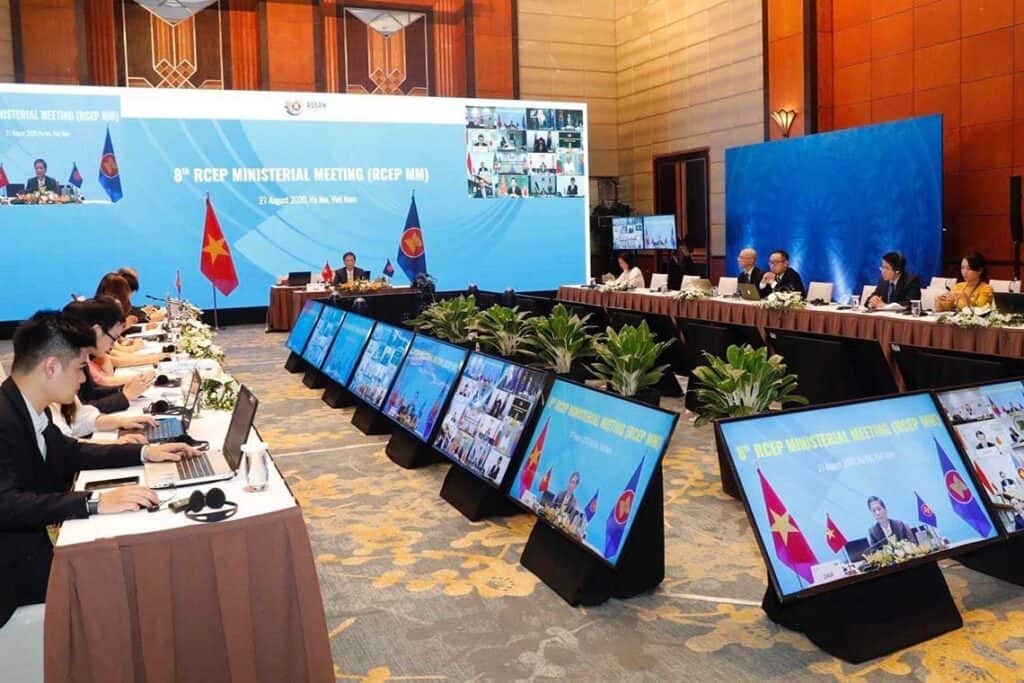
On November 15, the Regional Comprehensive Economic Partnership (RCEP) was signed by 15 nations. It has been heralded as the world’s biggest trade deal - and in many ways it is. <ul> <li style="list-style-type: none;"> <ul> <li>RCEP includes about 30 percent of the world’s population and economic output.</li> <li>It groups both Asia’s economically strong north, with the emerging southern nations.</li> <li>This marks the first time China enters a non bilateral free trade agreement of this scale. </li> <li>The RCEP isn't as comprehensive and doesn't cut tariffs as deeply as the TPP's successor. But many analysts think RCEP's sheer size makes it more significant. (BBC)</li> </ul> </li> </ul> The deal comes just when the UK is exiting the EU and the US is pulling back from multilateral trade pacts. This is the second big multilateral trade deal for Asia, following the Comprehensive and Progressive Agreement for Trans-Pacific Partnership, or CPTPP, signed in 2019. There is also the China-ASEAN trade agreement, signed in 2014. However, RECP will take already low tariffs on trade between member countries still lower, over time. Thus impact might not be as great as it is touted to be. RCEP does not herald a dramatic liberalisation of Asian trade. Its origins are as a kind of tidying-up exercise: joining together in one overarching compact the various free-trade agreements (FTAs) between the ten-member Association of South-East Asian Nations (ASEAN) and several other countries in the Asia-Pacific: Australia, China, Japan, New Zealand and South Korea, according to a report in the <a href="https://www.economist.com/finance-and-economics/2020/11/15/the-meaning-of-rcep-the-worlds-biggest-trade-agreement">Economist</a>. <h3><b>What Makes RCEP Noteable</b></h3> <ul> <li style="list-style-type: none;"> <ul> <li>The free trade framework extends beyond trade to set common rules and standards for a range of economic activity. (<a href="https://asia.nikkei.com/Economy/Trade/Asia-forms-world-s-largest-trading-bloc-RCEP-after-years-of-talks?utm_campaign=RN%20Free%20newsletter&utm_medium=daily%20newsletter%20free&utm_source=NAR%20Newsletter&utm_content=article%20link&del_type=1&pub_date=20201116123000&seq_num=2&si=16105506">Nikkei Asia</a>)</li> <li>It includes 20 chapters of rules covering everything from trade in goods, investment and e-commerce to intellectual property and government procurement.</li> <li>It's possible the new "rules of origin" - which officially define where a product comes from - will have the biggest impact. It makes one set of rules applicable for the entire region. (<a href="https://www.bbc.com/news/world-asia-54949260">BBC</a>)</li> <li>The RCEP agreement is loose enough to stretch to fit the disparate needs of member countries as diverse as Myanmar, Singapore, Vietnam and Australia. (<a href="https://www.aljazeera.com/economy/2020/11/15/rcep-15-asia-pacific-nations-set-worlds-biggest-trade-pact">Al Jazeera</a>)</li> <li>Unlike the European Union, it does not establish unified standards on labour and the environment or commit countries to open services and other vulnerable areas of their economies. (<a href="https://www.aljazeera.com/economy/2020/11/15/rcep-15-asia-pacific-nations-set-worlds-biggest-trade-pact">Al Jazeera</a>)</li> <li>RCEP shifts Asia from being integrated solely for the purpose of delivering goods to other markets, to supporting its domestic and regional markets as well. (<a href="https://www.ft.com/content/2dff91bd-ceeb-4567-9f9f-c50b7876adce">Financial Times</a>)</li> <li>The pact also provides for enhanced intellectual property protection and enforcement. Companies need only file a single patent or trademark application that would apply in other RCEP member countries. (<a href="https://www.straitstimes.com/singapore/politics/easier-cheaper-for-firms-to-do-business-with-rcep-chan">Straits Times</a>)</li> <li>It eliminates, by one estimate, about 90% of tariffs, but only over a period of 20 years after coming into effect (which will require all 15 countries to ratify it). (<a href="https://www.economist.com/finance-and-economics/2020/11/15/the-meaning-of-rcep-the-worlds-biggest-trade-agreement">Economist</a>)</li> </ul> </li> </ul> <h3> </h3> <h3><b>Key Beneficiaries of RCEP </b></h3> <ul> <li><b>Japan:</b> Tariffs on 86% of Japanese goods exported to China will be eliminated, up from the current 8%.</li> <li><b>China:</b> RCEP aligns with President Xi Jinping's new economic strategy of "dual circulation" - refocusing on domestic demand while taking advantage of trade and foreign investment.</li> </ul> <h3> </h3> <h3><b>Where’s India?</b></h3> In 2019, <a href="https://insidefashionlive.net/why-india-said-no-to-rcep/" target="_blank" rel="noopener noreferrer">India withdrew from RCEP</a> stating that it did not sufficiently protect India from the threat of a deluge of cheaper Chinese imports. The 15 members formally left the door open for India to join later. <h3><b>What About the US?</b></h3> The U.S. has a Pacific coast border and thus could have been included in the deal. It wasn’t. In great part this is because in 2016 presidential candidates Hillary Clinton and Donald Trump both opposed the Trans Pacific Partnership Agreement (TTP), which had been championed by the Obama administration. When Mr. Trump was elected president, he nixed the deal. RCEP presents a challenge for President-elect Joe Biden, who will try and reassert U.S. influence in the Asia-Pacific region to counter China. <h3><b>When Will RCEP Come into Effect?</b></h3> RCEP will take effect after at least six ASEAN countries and three non-ASEAN countries ratify it. <h3><b>Key Commentary on RCEP </b></h3> <ul> <li>"Japan at first said it didn't want to sign if India is not there because RCEP becomes too China-dominant without India," one ASEAN diplomatic source said on condition of anonymity. "But now it said yes, because there is no choice." (<a href="https://asia.nikkei.com/Economy/Trade/Asia-forms-world-s-largest-trading-bloc-RCEP-after-years-of-talks?utm_campaign=RN%20Free%20newsletter&utm_medium=daily%20newsletter%20free&utm_source=NAR%20Newsletter&utm_content=article%20link&del_type=1&pub_date=20201116123000&seq_num=2&si=16105506">Nikkei Asia</a>)</li> <li>"As far as India is concerned, we did not join RCEP as it does not address the outstanding issues and concerns of India," said Riva Ganguly Das, a secretary in the Ministry of External Affairs (<a href="https://asia.nikkei.com/Economy/Trade/Asia-forms-world-s-largest-trading-bloc-RCEP-after-years-of-talks?utm_campaign=RN%20Free%20newsletter&utm_medium=daily%20newsletter%20free&utm_source=NAR%20Newsletter&utm_content=article%20link&del_type=1&pub_date=20201116123000&seq_num=2&si=16105506">Nikkei Asia</a>)</li> <li>"The economic benefits of the deal might only be marginal for South East Asia, but there are some interesting trade and tariff dynamics to watch for North East Asia," said Nick Marro at the Economist Intelligence Unit (EIU).</li> <li>"Ratification will likely be tricky in national parliaments, owing to both anti-trade and anti-China sentiment," said Nick Marro at the Economist Intelligence Unit (<a href="https://www.bbc.com/news/world-asia-54949260">BBC</a>)</li> <li>Analysts are sceptical US President-elect Joe Biden will push hard to rejoin the trans-Pacific trade pact or to roll back many of the US trade sanctions imposed on China by the Trump administration given the widespread frustration with Beijing’s trade and human rights records and accusations of spying and technology theft. (<a href="https://www.aljazeera.com/economy/2020/11/15/rcep-15-asia-pacific-nations-set-worlds-biggest-trade-pact">Al Jazeera</a>)</li> <li>The ecommerce chapter was a particular disappointment. The 15 countries were unable to agree to any rules on cross-border data flows or a customs moratorium on data transmission, according to Deborah Elms, executive director of the Asian Trade Centre consultancy in Singapore (<a href="https://www.ft.com/content/2dff91bd-ceeb-4567-9f9f-c50b7876adce">Financial Times</a>)</li> <li>Some see RCEP as so unambitious as to be largely symbolic. Others see it as an important building block in a new world order, in which China calls the shots all over Asia. (<a href="https://www.economist.com/finance-and-economics/2020/11/15/the-meaning-of-rcep-the-worlds-biggest-trade-agreement">Economist</a>)</li> </ul>