



If it’s a cost you can bet it’s rising. That scenario is expected to last into Q1 next year, and likely drive up inflation in key global markets.
LOGISTICS
Rates to the US dropped this week on the back of reduced production (Golden Week, power cuts in China) and a rise in brands shifting to chartered ships.
Market demand from China to Europe is still consistently exceeding supply. Rates were stable in September and only increased marginally in October, according to Flexport data.
India to US routes find carriers looking to realign vessel schedules in an effort to increase schedule reliability.
Major US retailers, the Government and unions are working together to bring on 24/7 shifts at ports in order to clear up congestion.
- 500,000 containers are waiting to be offloaded at Los Angeles and Long Beach ports.
Air freight ex-Northern Vietnam continues to be extremely tight as ocean transit times are unable to catch the holiday season schedule, according to Flexport. As factories come back in Southern Vietnam, air freight will be the only option for meeting holiday deadlines.
PODCAST
Getting Good Returns is One Thing. Knowing How to Keep Them is Another
In this episode of A Seat at The Table, market forecasting expert Roger Khoury talks about:
- Why focusing on opportunities to make money is the reason people have bad or inconsistent market experiences and what to do instead.
- Why it’s critical to focus on the process, not the results.
- The “inherent flaw” in all market strategies that leads to large losses and inconsistency.
ENERGY
The Chinese government has agreed to raise electricity rates, encouraging producers to increase energy supplies.
The EU today (Oct 14) announced plans to mitigate the negative impact on households and businesses of rising energy prices, according to a European Commission statement.
MATERIALS
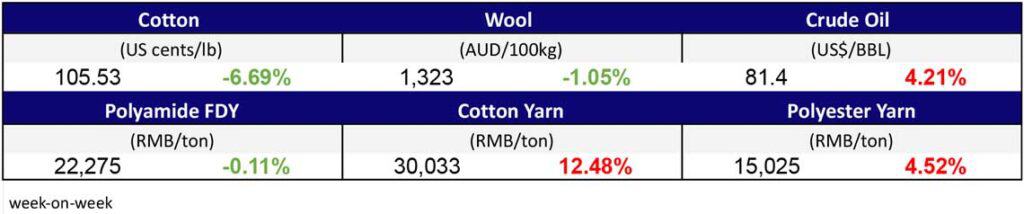
Cotton prices have risen 16% since early September, “trading at their highest price in roughly a decade due to speculation of surging Chinese demand for cotton imports,” per Credit Suisse research.
Shinkong Synthetic Fibers Corp (Taiwan) expects polyester prices to remain high in Q4 driven by higher oil prices. Since mid-September, the company has raised its prices 15% to 20%, and feels that they could go even higher.
Prices for ethylene glycol and purified terephthalic acid, two key raw materials used to produce polyester fibers, have surged.
Power shortages in China have reduced factory output of both chemicals and fibers.
YOU MIGHT HAVE MISSED THESE ARTICLES
- Now Who’s The Boss?
- Function + Creativity is Driving Activewear
- Could Things Get More Chaotic? Companies Think They Can
- Why Brand Partnerships are Becoming an Essential Retail Strategy
- How Sustainability Has Made Supply Chains More Resilient
- 5 Potentially Long Term Supply Chain Glitches
- Why Retail Needs a Entertainment First Strategy
- 5 Trends that China’s GenZ Consumers Favor
- “Business is Back” said Mills at Spinexpo
- Prints that are Sophisticated – and Sustainable
- Why China’s Mall’s Could be the Next Hot Properties
- The Tremendous Value of High Value Brands
- A Sustainable Supplier Specialized in Small, Customized
