

Investors are now betting heavily on rate cuts by May 2024, but Central Banks still are not convinced that recent dips in inflation indicate that it’s under control.
- Economists suggest that any rate cuts are likely to be a ‘slight tipping of the scales to ensure a soft landing’, per the Daily Upside.
- “There’s a higher chance that rates go higher, inflation doesn’t go away and [geopolitical tensions ] cause more problems of some sort.” – Jamie Dimon, CEO, JPMorgan
LOGISTICS

Despite reducing scheduled Asia – N. Europe capacity by 21% in November (with a 24% reduction announced so far for December), capacity still remained 11% higher than in 2019, showing that growing fleets and easing demand are combining to challenge rate increase attempts, per Freightos.
On Indian Subcontinent Routes November rate levels have been extended through the end of December. Although capacity is constrained due to blank sailings to the U.S. East Coast and high utilization to the U.S. West Coast market volume remains soft, per Flexport.
Eastbound through the Panama Canal, transits have been reduced to 32 a day, down from a normal of 36, and the canal is planning to incrementally reduce that number week over week to a projected 18 per day by February 1, per Flexport.
CMA CGM is launching a new Asia Subcontinent Express 2 (AS2) service that connects Asia with the Indian Subcontinent, on December 3rd, 2023.
Maersk has added a Karachi call to its recently updated FI3 ocean service this week. With the addition of Karachi to the rotation, Maersk brings direct coverage of the Far East markets to Pakistan’s importers and exporters with around 30% quicker transit times.
Month-on-Month ocean and air rate changes … new services … seasonal outlook. Read More
MATERIALS SOURCING
Mills are feeling the pressure to find new customers. With order sizes at the bare minimum, the only way to meet volume targets is to expand their customer base.
Then there’s the growing demand for better quality alongside equally strong demand for lower prices. Read more
PODCAST

What the New, More Resilient Supply Chains Might Look Like
Managing global supply chains has become one of the most challenging, risk intensive aspects of just about any business.
While the logistics crisis that rocked the past three years has now normalised, geopolitical issues are escalating, key retail markets are uncertain – at best – and then there’s the increasing pressure to meet more stringent demands for transparency.
In this podcast Christophe Roussel, industry consultant and former EVP Global Sourcing & Manufacturing at Gap, Inc. shares his vision of what next gen supply chains might look like.
You’ll Learn
- Practical and actionable ways to create more resilient supply chains
- How to balance the need for reliability with the quest for cheaper prices
- Which technology developments are likely to make the biggest impact on supply chain resilience
MATERIALS
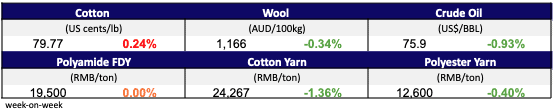
Cotton prices rose on concerns of lower output from India.
Oil prices continued to fall, defying forecasts that tensions in the Middle East would drive prices to $100/bbl.
You can find the current Month-on-Month and Year-on-Year prices here.
CURRENCIES
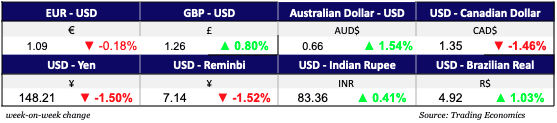
The dollar has extended its recent losses this week. Driving those losses have been Fed speeches welcoming signs of slowing economic momentum and lower inflation, per ING Bank.
The sharp decline in the dollar has boosted Asian currencies with the offshore yuan gaining 3% in November.
The euro depreciated this week, amid rising expectations of major central banks transitioning from tightening to rate cuts in the upcoming year.
MARKETS
Eurozone inflation fell more than expected to 2.4% in November, the slowest annual pace since July 2021, raising hopes that interest rates could soon be cut.
Spain’s headline inflation fell to 3.2% in November from 3.5% in October. Core inflation also cooled further to 4.5% in November from 5.2% last month, per the nation’s statistics office INE.
In France, consumer inflation fell to 3.4% in November, from 4% in October, per
Inflation is ‘becoming much more home grown’ and will force interest rates to stay high for longer, Sir Dave Ramsden, a deputy governor of the Bank of England has warned.
- Inflation is being driven by wages, where wage growth remains above 7%, per Sir Dave.
- Rates are expected to remain above 4% for several years.
The US economy grew at an annual rate of 5.2% in the third quarter, more than originally estimated, per the Bureau of Economic Analysis.
- The surge in gross domestic product has mainly been fueled by consumers who have continued to spend despite expectations of a slowdown.
- GDP growth was the fastest since the fourth quarter of 202.

YOU MIGHT HAVE MISSED THESE ARTICLES
- SE Asian Markets: Growing Fast, Spending More
- Why Consumers are Giving Canada Goose the Cold Shoulder
- Concert Merch Becomes a Growing Category
- Why Fortune Might Be Favoring Mainstream Brands
- Authentic Denim Becomes an Incubator for Sustainability
- What Do You Do When the Money Runs Out?
- Super Markets Seize the Fashion Market
- Interfiliere Shanghai: China Re-energizes Intimate Apparel
- Why Mango is Beating Other Fast Fashion Brands
- A New Toolkit for Winning in a Tough Retail Market