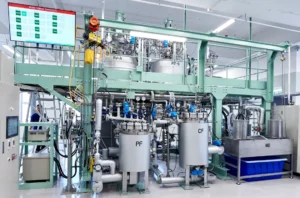
Can Technology Make Circularity Work at Scale?
New technologies, like AI sorting, fiber separation, and automated disassembly, are solving key obstacles so textile recycling can work at
Technology
/ Automation and micro-factories are enabling faster, more flexible production in a volatile sourcing environment.
For decades, apparel sourcing has moved production to where labor is cheapest and production could be scaled in large factories. That’s still the prevailing model but a range of pressures from rising costs, to economic uncertainty and geopolitical tensions is forcing brands to rethink their sourcing strategy.
Micro automation and micro-factories are emerging as part of that shift.
The question is how will this impact global supply chains.
To continue reading, please login
Related articles

New technologies, like AI sorting, fiber separation, and automated disassembly, are solving key obstacles so textile recycling can work at


AI, predictive data and connected systems are turning supply chain visibility into faster, more automated decisions

AI and better product data are turning 3D from a visualization tool into a connected product-development system

Insights & Analysis