
Vietnam’s Sourcing Is Splitting in Two—See the Full Comparison at a Glance
A sharp side-by-side comparison of Vietnam’s primary vs. secondary sourcing hubs—10 criteria that every sourcing leader needs to know.
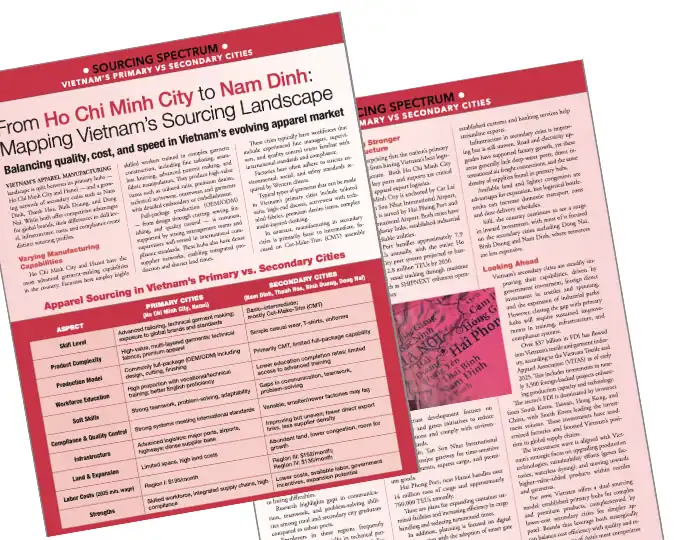
Vietnam’s apparel manufacturing landscape is split between its primary hubs — Ho Chi Minh City and Hanoi — and a growing network of secondary cities such as Nam Dinh, Thanh Hoa, Binh Duong, and Dong Nai. While both offer competitive advantages for global brands, their differences in skill level, infrastructure, costs, and compliance create distinct sourcing profiles.
Get the Full Vietnam Comparison
Side-by-side table covering 10 key criteria (wages, QC, infrastructure, compliance, etc.)
Sharp overview—save hours of research, get clarity at a glance
Practical insights for sourcing executives
Varying Manufacturing Capabilities
Ho Chi Minh City and Hanoi have the most advanced garment-making capabilities in the country. Factories here employ highly skilled workers trained in complex garment construction, including fine tailoring, seamless knitting, advanced pattern making, and fabric manipulation.
Vietnam’s Primary vs. Secondary Cities: Apparel Sourcing Capabilities
Download the PDF file to see the Comparative Data Table.
Related articles

Portugal: A Nearshore Hub for Premium Apparel
Portugal combines EU-standard quality, fast turnaround and small-batch production, giving brands a nearshore option for premium programs and test-and-repeat models.

Mexico Repositions as North America’s Nearshore Hub
Two-day transit times and duty-free access under USMCA are reshaping sourcing calculations for North American brands.

West Africa Emerges as a Park-Led Apparel Sourcing Region
SEZ-driven platforms in Benin and Togo are anchoring early export growth, while Ghana rebuilds capacity around renewed trade preferences.