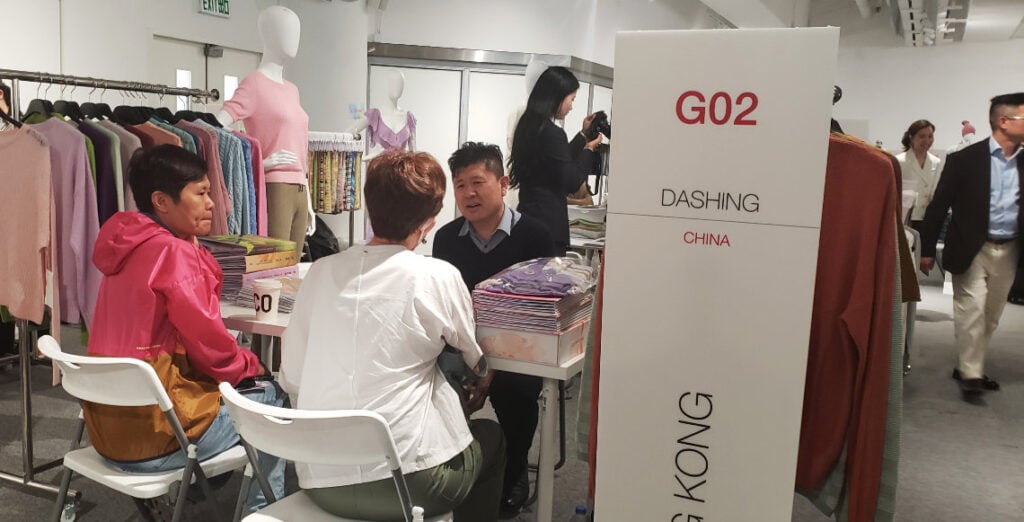
The market is slowly finding its floor. After a year long post pandemic readjustment, the industry is realizing that new benchmarks have been established.The new reality is that the market is not ‘going back’ to 2019. At SPINEXPO Hong Kong (February 21-22) spinners acknowledged that times had changed. But also that the market was starting to improve - slowly, after a painful 2023.Today’s market is characterized by smaller (much smaller!) orders and much shorter lead times. And, the recognition that undifferentiated products no longer sell - even at cheap prices.There’s also a growing recognition that consumers want quality. Yes, teens, tween and even your Junior customers are snapping up cheap, trendy fast fashion. But they are just one subset of the entire market.In most other market segments, people are looking for ‘better’. “We are moving to high end products, like 100% cashmere. The low end is not doing very well,” said Bella Chen at Shanghai Fucen Textile Technology Co, Ltd. The demand is not only for higher quality fibers, but also for more elevated innovation.Spinners agree the market wants smaller volumes with better quality - preferably at lower prices.“We need to differentiate. Customers will only choose you if you have something different. If you have something that is a bit different you can succeed, even in a tough market,” said Charles Wang, general manager at New Dynasty. “We have to do a lot more R&D in order to be competitive,” said Allen Ju at Haite Fashion Textile. “Customers want better quality, but at lower prices,” he said. His company had created fancy yarns from cotton and cotton blends, including a new ombre effect achieved through the way the yarn was spun, instead through dyeing.There’s also more pressure on suppliers to handle more of the design development on behalf of the brands. An increasing part of this work is being pushed upstream, with manufacturers in some cases almost replacing much of brands' design teams.“Customers want more inspiration from manufacturers. They have reduced the number of people on their design teams and really rely on the factories,” said Bella Chen. Bella Chen at Fucen Textile Technology Charles Wang, general manager at New Dynasty Small is Playing a Bigger RoleAnother market reality is the growing role of smaller brands. After several decades dominated by national and international brands, the balance is shifting towards far fewer big brands and a lot more small, independent brands.E-commerce and social selling has helped provide a channel for even micro brands to get a toehold in the market.While most of these brands are very small, the aggregate of them is accounting for a growing share of the market. At the same time, the bigger brands are no longer willing to commit to placing big orders. No one has the appetite for risk right now - and carrying inventory can be very risky (and expensive) in an uncertain economic environment.“We lost some customers who didn’t survive the pandemic years. However 2024 will be a better year for us since we can handle small orders. This is what customers want now,” said Levi Chan at United King. Jacky Wang, vice general manager at Daxing Cashmere Products Jacky Chein (right) managing director at Best Shan It’s not only Chinese domestic brands that are playing a defining role in the smaller-but-faster order movement.Indie brands from the US, as well as from Canada and the EU are now on the radar of spinners and knitters.“We do a lot of small quantities with customers we find on Alibaba,” said Cherry Li at Siwei. “It’s a good business for us since customers pay cash in advance through Alibaba’s platform. There’s no QC or QA. Since the order sizes are small, we just send them to the US by DHL, so we avoid import documentation,” she said.Siwei is very optimistic about 2024, expecting that orders will continue to grow.Also contributing to the ‘smaller but better’ are Russian brands.“A lot of the brands in Russia are doing very well. The demand there is for luxury fibers. The foreign brands that exited the market have been replaced by domestic brands, which are doing quite well. With less competition from international brands, they have had more opportunity to grow,” said Bella Chen at Fucen Textile Technology. Arvin Wu at SPINZ Dorothy Lam at Consinee Group Mixed Market ConditionsSpinners were divided over which market was likely to perform the best this year.The consensus was that Western markets were recovering - but very slowly. In an unexpected turn of events, more spinners were saying that the China domestic market is quite good - especially for better quality products.“The China domestic market is benefitting from all of the small brands that sell online. Some are selling half a million pieces. They are selling 10,000 to 20,000 pieces from just one video. The brand sells out and then offers a new product. Business from these brands is very good,” said Arvin Wu at SPINZ.“Exporters are facing more problems. But the factories supplying domestic brands are working 24 hours to meet the e-commerce demand because the cycle is very fast. There’s no 180 days delivery like in exporting,” he added.For suppliers, selling to the domestic market can be less risky. “Consumers pay for the garments in advance. This gives the brands cash to pay their suppliers. The cycle is very fast. There’s no risk on inventory. No risk of not getting paid. But for the factory, the lead times are very short,” he said. Despite a sluggish economy, China domestic demand is not only picking up, it's moving towards better quality.“The high-end products are in demand. The market wants better quality. We’ve seen about a 20-30 percent increase in demand,” said Bella Chen at Fucen Textile Technology.“There are many new brands on TaoBao - and all are high end. Most are using 100% natural fibers - and they are selling very fast,” she added. A man sitting at a table in a room full of people. Cherry Li (middle) at Siwei Textile Technology Looking AheadThe global market is still clearly in a recovery phase. It is unlikely that things will go back to the ‘good old days’. However there are pockets of opportunities. The challenge for brands, retailers and suppliers is to figure out how to adjust their business models to meet the new demand where it is - which is smaller, faster and better.