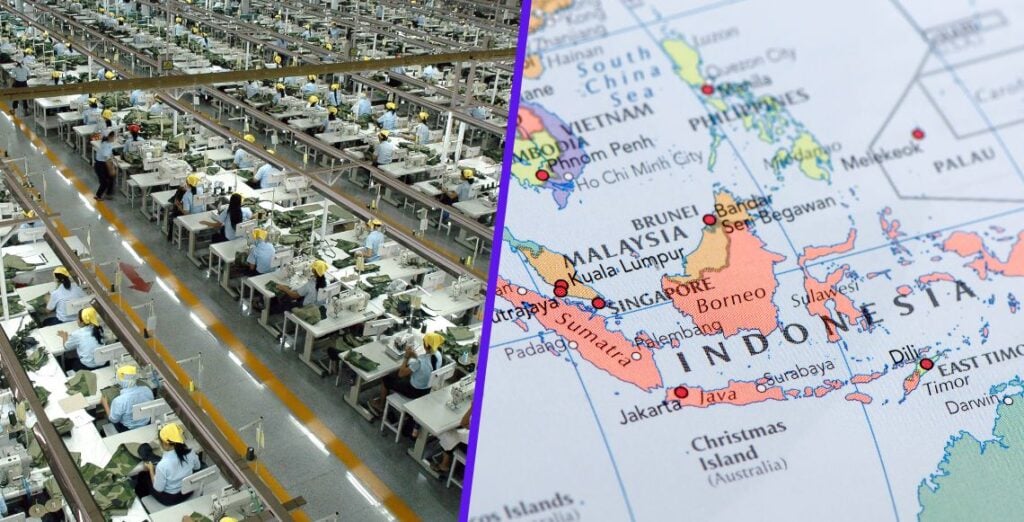
Despite its heritage as being one of the world’s leading apparel producers, Indonesia’s industry has been living in the shadows of its neighbors. For most brands it ultimately always came down to Vietnam being faster and Cambodia being cheaper. Indonesia wasn’t the most expensive, but it was still more costly than other garment producing nations.That’s starting to change. As brands look to diversify sourcing, a growing number are taking another look at Indonesia - and they are appreciating what they are seeing.“Compared with elsewhere in the world, the political situation in Indonesia right now is much more stable.”“Compared with elsewhere in the world, the political situation in Indonesia right now is much more stable,” said the managing director of the Indonesian and Malaysian sourcing office for a major U.S. mass market retailer, who requested not to be named.In addition, “The government has since instituted a lot of labor friendly legislation which has given protection to workers including new policies for overtime, holidays and wage protection,” he said.“Indonesia and the Western nations share the same values when it comes to freedom of speech. We are not a perfect country, but we have a passion for democracy. And we are committed to protecting our environment,” said Anne Patricia Sutanto, Vice President-Director at Pan Brothers, a $680 million Indonesia apparel manufacturer. Download the Sourcing Spectrum table to see how Indonesia compares with other regional manufacturing nations. DOWNLOAD That All-Important Domestic Supply ChainAfter several years of logistics logjams, the importance of having your entire supply chain under one roof was made clear.Indonesia has this advantage with a strong supply chain from fiber to fabric for synthetic textiles and a growing supply of cotton fabrics.“Fashion has very tight lead times so the fact that we don’t need to lose time transporting the fabric enables us to meet production targets,” said Iwan Setiawan Lukminto, President Director of Sritex Group, a vertically integrated manufacturer that goes from yarn spinning to finished garments.Sritex produces a wide variety of fabric including cotton, rayon, polyester, polyamide and their blends and has regular production of many of their fabrics so that also shortens lead times.To solve the problem of having to wait for shipments of cotton, Indonesia established a bonded warehouse so that an ample supply of cotton was immediately available to its mills.Another strength is the nation’s population of about 273 million people, which is also served by its apparel industry. In 2022, only 30% of Indonesia’s apparel production was exported. For mills, investing in Indonesia enables them to capitalize on both its export market and its domestic market.Under the recent implementation of Indonesia’s Omnibus Law, 100% foreign ownership is encouraged.Adapting to Smaller OrdersOne of the biggest shifts in the apparel industry has been the dramatic drop in volumes. Even big brands want the flexibility of smaller orders.“We are quite different from most of the factories who usually focus more on the volume business. We work with smaller MOQs and offer more attention to detail. For example, we have our own embroidery facilities,” said Michelle Tjokrosaputro, owner of Dan Liris.“We are a ‘boutique’ factory that can do more personalized orders. We really cater to those small to medium sized brands that have more detailed orders,” she said, explaining that around 60 percent of Dan Liris’s orders are for less than 200 pieces and can be even a lot smaller than that.Although Dan Liris specializes in smaller orders their annual output is quite sizable producing 7.5 million garments each year. That’s supported by 39.5 million meters per year of dyeing and printing capacity.Embracing Industry 4.0One of the reasons brands shied away from Indonesia was price. However, as factories are quick to point out, cheap prices can sometimes be more expensive in the long run.Margins in Indonesia are thinner but production systems are more advanced. Many factories are implementing successful just-in-time (JIT) strategies, Kaizen practices and Six Sigma management, according to many of the leading factories.“We are a company that really pushes forward on industry 4.0 and uses automation to help less skilled workers be more productive, as well as assist our skilled workers in doing more complicated tasks,” said Ms. Sutanto.“As early as 2010 we recognized that digitization was the future for manufacturing. Over the years we’ve been integrating this into our factories. Each factory is continuing to be upgraded,” she added.Eyeing an EU FTAA potential game changer for Indonesia would be establishing a free trade agreement with the EU, something which has been under negotiation since 2016 and has seen 11 rounds of negotiations. “The EU is negotiating a Free Trade Agreement (FTA) with Indonesia with the objective of facilitating and creating new market access, increasing trade and investment between the EU and Indonesia, and promoting sustainable development.“The aim is to conclude an agreement similar in coverage to what the EU achieved in its trade agreements with Singapore in 2014 and Vietnam in 2015,” the European Commission said in a statement.There is no indication as to when an agreement might be signed.Investing in the Industry’s FutureWhile many countries view the textile industry as a sunset industry, no one can deny the role it plays in employing high volumes of workers. In particular, it is a stepping stone for unskilled or low skilled workers to work their way up from more manual labor jobs.In 2022, the Indonesian government invested over US$658 million in the textile and garment sector, doubling its 2021 investment. This investment is being particularly applied towards innovative production, updated machinery, automation, digital printing and improved energy use and waste management.Manufacturers are driving the industry forward through investment in R&D.Sritex, for example, has invested in building its own R&D center where it continually works on new fabric developments.The future looks strong for Indonesia’s apparel industry, particularly as more brands look for sourcing locations that are stable, have a complete domestic supply chain - and are investing in greater efficiency.