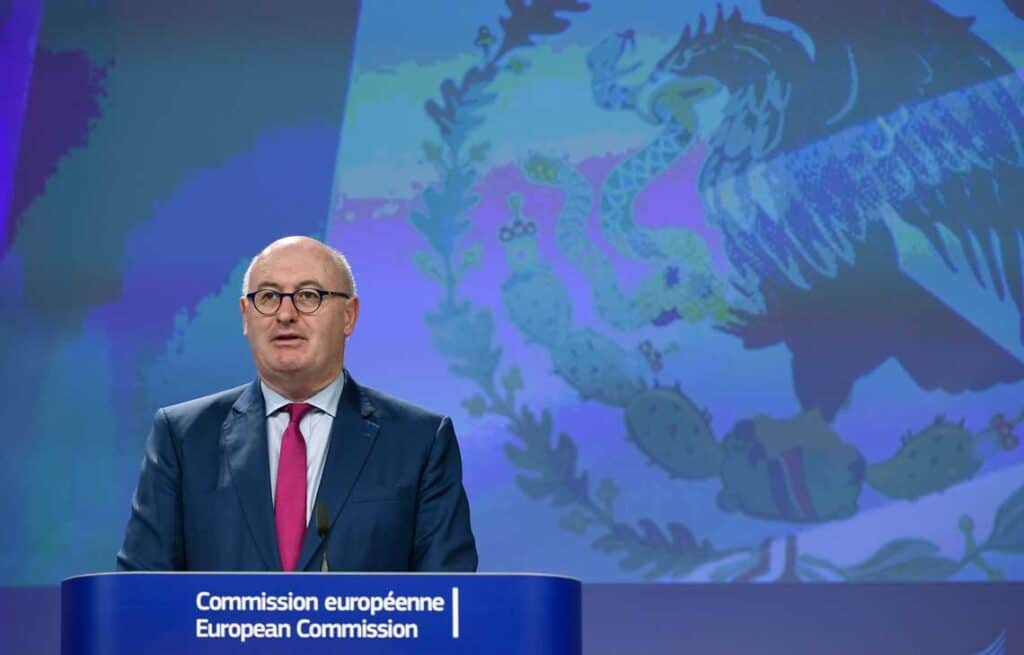
The European Union announced on March 27 it has teamed up with China and 14 others to set up a temporary system for trade dispute appeals in place of the World Trade Organization's Appellate Body.The countries' Multiparty Interim Appeal Arbitration Arrangement comes three months after the WTO's Appellate Body was whittled down to one member unable to hear new cases, the result of the Trump administration's decision to block new appointments to the panel, according to Law 360."This is a stop-gap measure to reflect the temporary paralysis of the WTO's appeal function for trade disputes," EU Commissioner for Trade Phil Hogan said. “We will continue our efforts to restore the appeal function of the WTO dispute settlement system as a matter of priority.”7 Key PointsUnder the agreement, trade dispute appeals between coalition members will be resolved by an interim panel of three arbitrators, which will be selected from a pool of 10. (Reuters)The temporary appeals procedure will keep the core features of the WTO's formal arbitration system, according to the coalition's agreement.The WTO's Appellate Body, which acts as the final arbiter for international trade, has been frozen since December 2019, when two judges' terms lapsed, leaving one judge on the seven-seat body. A minimum of three judges is needed for the body to take up new cases.Ahead of the shutdown, other WTO members have looked to create an interim system, which is permitted under the WTO's rules allowing individual governments to appeal decisions to an independent arbitrator.WTO members involved had agreed to preserve the WTO’s two-step dispute system until the WTO’s own Appellate Body became operational again.All WTO members are welcome to join.In addition to the EU and China, other nations that have joined include Australia, Brazil, Chile, Colombia, Costa Rica, Guatemala, Hong Kong, Mexico, New Zealand, Singapore, Switzerland, and Uruguay.Why the US Opposition?Concerns over he WTO Appellate Body “overreaching” and overstepping its authority with “erroneous interpretations” of international trade agreements in addition to “failing to comply with WTO rules” and “addressing issues it has no authority to address.” (Law 360)The US also takes issue with judges being able to continue working on cases after their term has ended.In a news release in February U.S. Trade Representative Robert Lighthizer said that the Appellate Body’s conduct “has converted the WTO from a forum for discussion and negotiation into a forum for litigation.” The Big IssueThe European Union delegation has expressed support for updating the WTO's dispute settlement rules, but feels that the U.S. is undercutting efforts to do this by taking what it sees as an ‘obstructionist’ approach.The issue isn’t whether or not the WTO needs to evolve from its original rules. It’s a matter of how those rules should be redefined that is at the heart of the standoff. This now part of a bigger issue - the power struggle amongst nations as the global economic leadership evolves to include more countries.