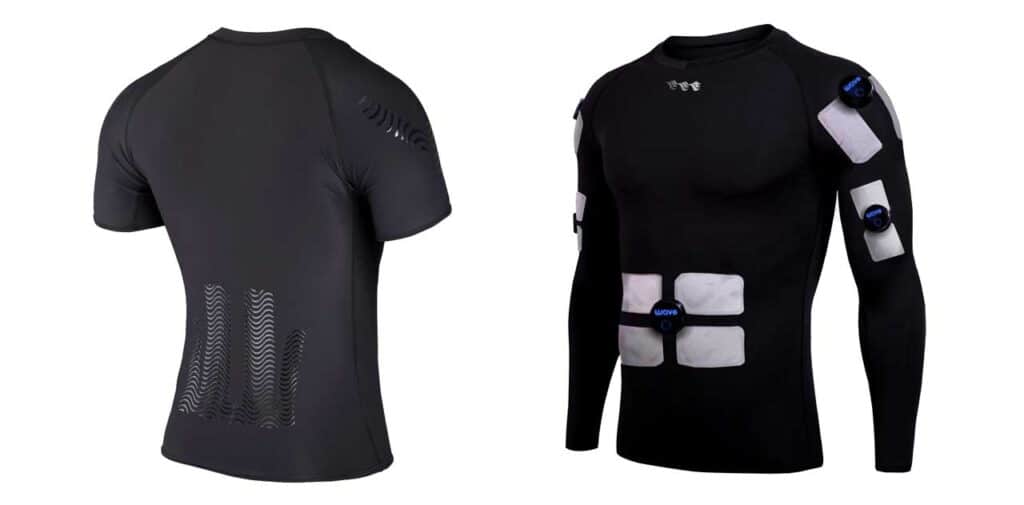
<h3><strong>Fatigue Reducing Sportswear</strong></h3> Wave Company (S. Korea), a sports garment technology company, has developed EMS (Electronic Muscle Stimulation) suit - WaveWear. The company has developed the world’s first performance wear using genuine kinesiology taping of WaveWear. You can experience the advantages of kinesiology taping and compression wear by just wearing the garments. Wave Company's WaveWear drastically reduces muscle fatigue while WaveWear’s proprietary BWAS, the bio waved adhesive silicone, closely aligns and adheres to the human skin to provide similar effects of conventional kinesiology taping that is used prominently by athletes. It is used for physical therapy for various effects such as pain-reducing, posture correcting, performance-enhancing, injury prevention and more. WaveWear combines the advantages of kinesiology taping compression wear into one unified product. The compression provided by WaveWear has been optimized to maximize blood flow while minimizing muscle vibration to help reduce fatigue. Based on clinical tests, WaveWear reduces muscle fatigue as much as 35% compared to other normal compression wear and bears in watered conditions which is much better than conventional kinesiology taping. Currently, the company is developing a new type of the Electrical Muscle Stimulation (EMS) functional garment. The EMS wear is a wearable suit that utilizes modulated mid and low frequency current during exercise. It uses carrier frequency to enable muscles to work out, not affecting the joints. This is one of the core technologies of VR haptic tactile wearables. The WaveWear clothing will be launched on Kickstarter, the World’s biggest crowdfunding platform, in January 2020. <h3><strong>A T-shirt You Can Talk to To</strong></h3> A research project led by Nottingham Trent University (UK) could let you use your Tshirt as a mobile phone. The university s Advanced Textiles Research Group (ATRG) has been given £1.3m to advance the technology that will pave the way towards the world s first wearable computer. The project aims to create a manufacturing process to enable complex electronic circuitry to be embedded into yarns on an industrial scale. The research group “ which has already pioneered technologies such as clothes embedded with solar cells to charge mobile phones “ will develop the process for creating electronic yarns “ or E-yarns - over the next three years. Professor Tilak Dias, who leads the ATRG, in the university's School of Art & Design, said: “This project will allow us to take a quantum leap towards seeing wearable E-textiles on the open market. Complex E-yarns circuitry “which is undetectable to the wearer “will allow for the development of wearable electronics as sophisticated as computers. <blockquote> This project will allow us to take a quantum leap towards seeing wearable E-textiles on the open market. <footer> <cite>Professor Tilak Dias</cite> </footer></blockquote> “It could literally mean that in the future your T-Shirt or jacket could be used as a mobile phone, with your collar being used to speak in to. But to the naked eye, it would appear like any other item of clothing, and none of the technology would be felt by the wearer. “The garments would also be fully washable and wearable, like any other form of clothing. But embedded into the yarn of the fabrics would be high-tech electronics which can monitor your heart rate, your blood-oxygen levels, be used as a communications device, and more. Co-investigator Dr. Theodore Hughes-Riley added said: “For years we have developed a range of high-quality working concepts, but this project will enable us to take our research from prototypes to the production line. “It will enable private companies, for the first time, to consider the realistic prospect of manufacturing these electronic-textiles en masse which have the potential to change people s lives.