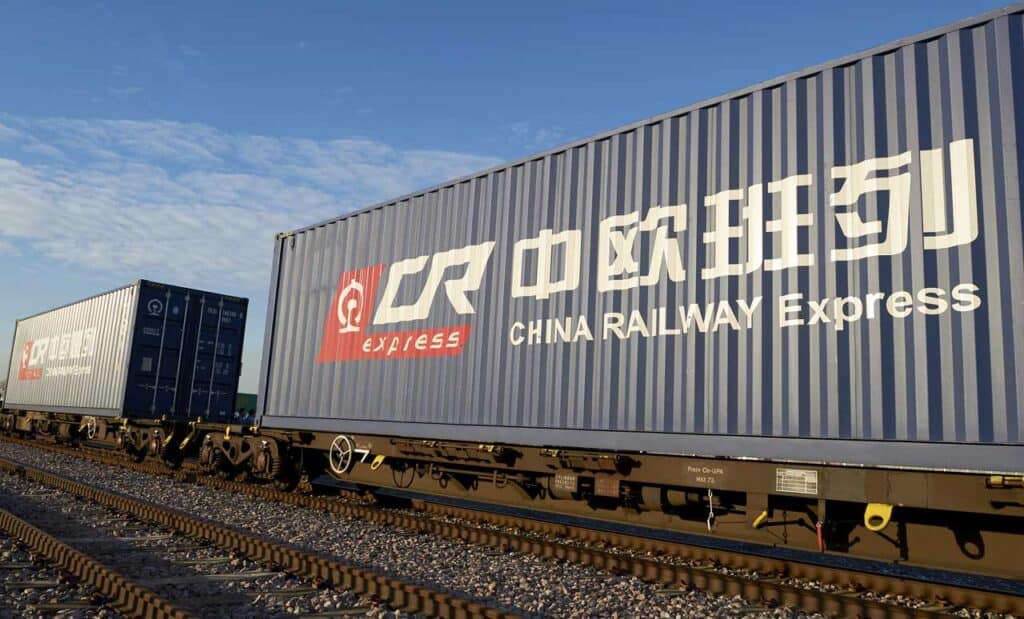
Exporters are getting a welcome cost reduction as shipping rates from Asia to Europe fall. Strong growth in container volumes has pushed rates down by nearly 70 percent. This includes rail container shipments via Uzbekistan. The average price to transport a 40-ft. high-cube container from China to Poland or Germany is now about $4,000 with a transit time of 15 to 18 days. That compares with about $9,000 to ship the same container from Shanghai to Warsaw in 2010, according to a United Nations comparative study on Europe-Asian transport links. Shipping a 40-ft. container by rail from Shanghai or Guangzhou to Almaty, the former capital of Kazakhstan, is about $2,500, a drop of nearly 69 percent compared with the 2014-15 price of about $8,000. Container volumes on the four main China-Europe rail routes jumped almost 30 percent year over year to 324,700 TEU in 2018, according to data from Belarusian Railway. That number could climb to more than 20 trains a day, the European Commission said in report published in February. Almost 77 percent of container traffic between China and Europe in 2018 used the Central Corridor linking China, Kazakhstan, Russia, Belarus, and the European Union, mainly via the Alashankou-Dostyk crossing on the China-Kazakhstan border, according to the European Commission report. <h3>Efficiency Improments</h3> Logistics companies have also said that more efficient operations at the border is helping to boost volumes. Kazakhstan and China have simplified passage of transit shipments, while customs has also become simplified and more transparent in order to facilitate transit times. Currently, container trains run between 50 cities in China and 40 cities in Europe, according to Belarusian Railway. The increased capacity provided by new routes and connections has also helped make transit times faster and more reliable. <h3>Expanded Service</h3> DHL, one of the first freight forwarders to start block train services, is building its own block train connections from the Chinese hinterland to hotspots in Europe. The company is implementing new routes to bypass congested areas. InterRail, part of the Swiss-headquartered TransInvest group, recently expanded its services with a block train connection from Changsha in central China to Malaszewicze, Poland, and Duisburg and Hamburg, Germany. Pottharst said TransContainer, part of Russian Railways, and Kazakhstan multimodal operator KTZ Express are also planning to expand their container rail business between China and Europe. Maersk Line has said it plans to double the volume of containers moved by dedicated freight trains from China to Europe this year, utilizing three new routes to avoid the potential choke point at Malaszewicze.