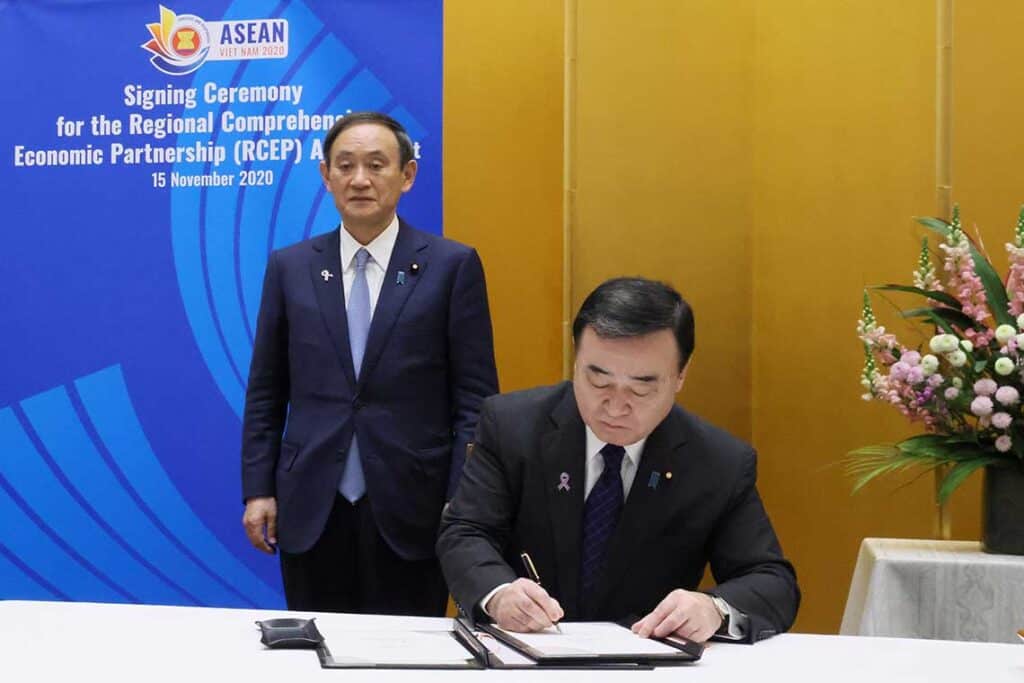
On April 28, 2021, Japan officially ratified RCEP taking the mega trade pact that includes 30 percent of the world’s economy one step closer to reality - a reality that could come as early as this year.China has already assumed a leadership role in the arrangement and will inevitably see its clout increase over the Asian economic order. The agreement includes the 10 member countries of the Association of Southeast Asian Nations as well as China, Japan, South Korea, Australia and New Zealand.Although multinational trade agreements are nothing new, this one is surrounded by concerns of nations that are both part of the pact and those on the outside.Key Global ConcernThe concern - both spoken and unspoken - is the rise of China’s power in both Asia and on a global scale. Of particular concern is the growing rivalry between the U.S. and China, a situation that a number of trade experts and political watchdogs fear could escalate to an uncomfortably “tense” situation.The question of where to stand with regard to China is a growing concern for many nations. India opted out of RCEP fearing that cheap Chinese goods would flood their market.Japan fiercely debated joining, but the concern over a new economic order emerging without Japan's involvement won out in the end.Had the U.S. gone ahead with plans to enter the TPP, it could have had a strong presence in Asia. The decision by the previous and current U.S. administrations to shift their focus to the domestic market, seems to indicate less will to take a strong role in Asia.The QuadWhile RCEP is clearly a China-led pact, more attention is being paid to the Quad - a four nation pact, with the U.S. and India, along with Australia and New Zealand, creating a counterweight of sorts to China.The four countries are already starting to collaborate on important infrastructure, such as data communication and energy.European countries are showing a growing interest in the Quad.The Quadrilateral Security Dialogue is a framework that deepens regional cooperation between members of the free world. It has been a poster child for the "free and open Indo-Pacific" concept led by Tokyo and Washington.As efforts to create a "China-free" supply chain accelerate, India is likely to be a key beneficiary. If it can successfully ramp up infrastructure and gain more cooperation amongst its states, it could become a key China-alternative, something it has often talked about but has not accomplished.What RCEP Actually DoesRCEP codifies the removal of tariffs mostly on items that are already exempted due to other free trade deals.It has a large loophole under which countries can maintain tariffs in a broad range of sectors; it will not result in some massive increase in intra-regional trade in the short term.RCEP should help multinationals from Northeast Asia build more seamless supply chains throughout the RCEP bloc and help united Northeast and Southeast Asian economies, according to the Council on Foreign Relations.Other Regional Trade PactsIn a sense, RCEP seems like a redundancy given the number of bilateral, multilateral and regional trade agreements already in existence. China is already part of the China-ASEAN trade agreement.Australia has trade agreements with Japan, Korea, China, Thailand, Indonesia, Malaysia - and is part of the CPTPP.New Zealand has a similar number of trade pacts.Japan has trade deals with most of the RCEP members already.