










SCS Aug 11
Shipping volumes lurch towards a decline; Marketplaces could be a new channel for mfgs; Materials prices start to soften

Share This Post

“Market crises are painful, inevitable and ultimately surmountable.”   – Shelby Davis, legendary investor & money manager 

LOGISTICS

Freight Rates Aug 10,

Schedule reliability has improved on a year-on-year basis to 40%, but six out 10 boxes are still arriving at port late, according to Sea-Intelligence.

The outlook for the U.S. market is a decline in volumes compared with 2021 over the next few months, and the decline is expected to deepen in 2023, according to Ben Hackett at Hackett Associates. He noted that “the heady days of growth in imports are quickly receding.” 

Despite being firmly in the typical peak season months, many are not expecting a coming increase in rates or volumes on the transpacific or Asia to Europe routes, said Freightos.

Spot rates continue to fall on Asia to North America routes with blank sailings on the rise.  Schedule reliability among the alliances remains low and varied, said Flexport.

Supply on Asia to Europe routes is still relatively tight due to the large amount of blank sailings, vessel sliding, and port omissions, per Flexport. 

UPS said it  will lower its surcharges by nearly 17% on heavier-weighted shipments moving from Asia to the US. The reductions will affect shipments moving under UPS Worldwide Express Freight service, where palletized shipments weighing more than 150 pounds are typically delivered in one to three business days.

ENERGY

The price of coal has tripled so far this year, in line with rising oil and gas prices.   The International Energy Agency (IEA) is now predicting an all-time-high coal demand this year, as Europe faces shortages due to the ban on oil and gas imports from Russia.

  •   Coal demand is likely to increase further next year to a new all-time high, according to the IEA’s latest Coal Market Update.

PODCAST

KD Angle

A Leading Commodities Insider Discusses Current Market Conditions

Commodities prices seem to have a mind of their own.  Inflation is surging, even though consumer demand continues to weaken.

After years of talking, central banks are now actually starting to raise interest rates. 

Despite what looks like a recession, many economists are saying that things are not as bad they look, while others are saying hard times are ahead.

K.D. Angle, author of “Guillotine Investing:  Keeping Your Head While Others are Losing Theirs”  and a veteran trader with a stellar track record discuss what he sees happening.

What You’ll Learn

How have markets changed over the past decades – and what actually hasn’t changed?

What should most people be looking to invest in now?

What most people often misunderstand about market performance.

🎧  Listen to the podcast

MARKETS

The Federal Reserve Bank is seen as raising interest rates by another 75 basis points at its September meeting.

Financial markets expect the Bank of England’s base rate to peak at about 2.8% by next May and then to fall to 2.5% to combat the deepest recession in 15 years.

The U.S. consumer price index rose by 8.5% year-on-year in July, decelerating from a 9.1% year-on-year increase in June, as inflationary pressures eased on the back of lower gasoline prices.

  • There was no increase between June and July, compared with a 1.3% monthly increase recorded in June.

DISTRIBUTION CHANNELS

Mfg on Marketplaces

Are Marketplaces a New Channel for Manufacturers?

Manufacturers are looking for new markets.  Brands are looking to get rid of excess stock.  It might seem counterintuitive, but marketplaces might provide an easy-to-use, low cost distribution channel.   Read more

MATERIALS SOURCING

Nan Yang Hero newsletter

Using New Technology to Help Brands Create New Developments and Reduce Costs

Top tier manufacturers have gone from producing orders to taking a lead role in creativity, fabric development and garment innovation.

Now world class companies like Nan Yang are operating their own innovation centers that are leaning into 3D technology.   Read more

MATERIALS

Materials Prices Aug 10,

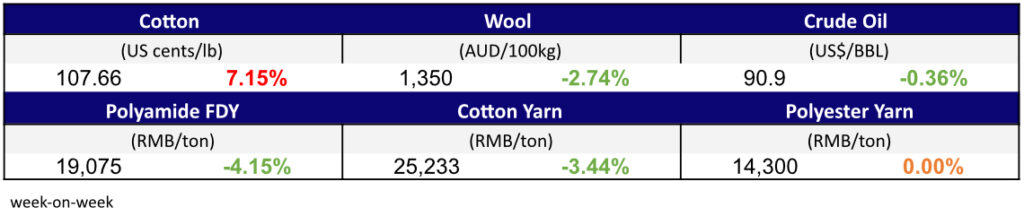
Concerns that cotton  could be short-supplied in the current cotton season ending September 2022 pushed prices higher this week.

After hitting a record high in recent months, weaker global demand is forecast to push Indian cotton prices down by as much as 45% by December, according to industry estimates.  

Subscribe To Our Newsletter

Get updates and learn from the best

More To Explore

Welcome Back!

Login to your account below

Retrieve your password

Please enter your username or email address to reset your password.

error: Content is protected
