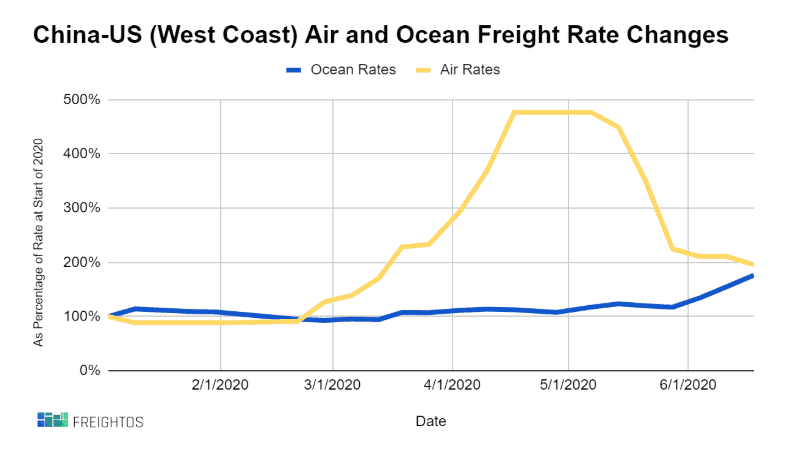

Ocean rates have rocketed this month, while air freight rates are continuing to retreat from their peak during the height of the pandemic, according to Eytan Buchman, CMO, Freightos.
Key insights:
A tale of two modes: While ocean rates spiked in June (60% since end of May, China-US West Coast, with this week’s rate surpassing the November 2018 previous all-time FBX high), air cargo prices have dropped 60% from their April peak (see graph above).
The recent increase in demand may have made ocean carriers more optimistic about the return of volumes: only 6% of capacity has been cancelled through July, much less than expected.
Fewer cancellations could also show that some carriers will opt to announce cancellations throughout the quarter instead of in advance, and try to avoid the mismatch of supply and demand that led to the June spike.
China-US rates:
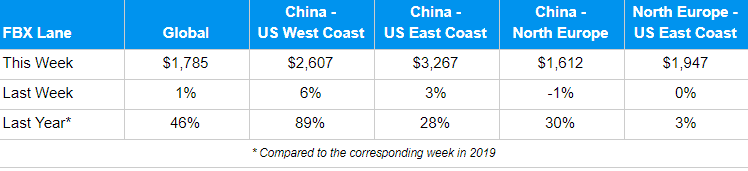
China-US West Coast prices (FBX01 Daily) climbed 6% since last week to $2607/FEU. This rate is higher than the November 2018 trade war, pre-tariff peak, and is 89% higher than the same time last year.
China-US East Coast prices (FBX03 Daily) rose 3% since last week, reaching $3267/FEU, and are 28% higher than rates for this week last year.
Analysis
Ocean rates from China to the US climbed less dramatically than the last few weeks as an increase in orders and restricted capacity continue to put pressure on prices.
This surprise mini-surge may have some ocean carriers hopeful for a potentially salvageable peak season:
The latest tally of cancelled sailings for Q3 – including some recently reinstated ships – show only 6% of Asia-US arrivals in July have been removed, with a similar trend on Asia-Europe lanes.
These schedules would set capacity well above the double digit drop in imports that’s being projected for the quarter, with ocean capacity getting back to more normal levels by the end of July.
But the June capacity restrictions put in place at the start of Q2 forced some BCOs to deal with delays and extremely high freight costs in the middle of a recession.
So, fewer announced cancellations may also show that carriers are actually being more cautious:
By opting to update schedules as needed throughout the quarter instead of in advance, carriers may hope to be more nimble in responding to demand shifts and avoid big swings like this month’s as much as possible.